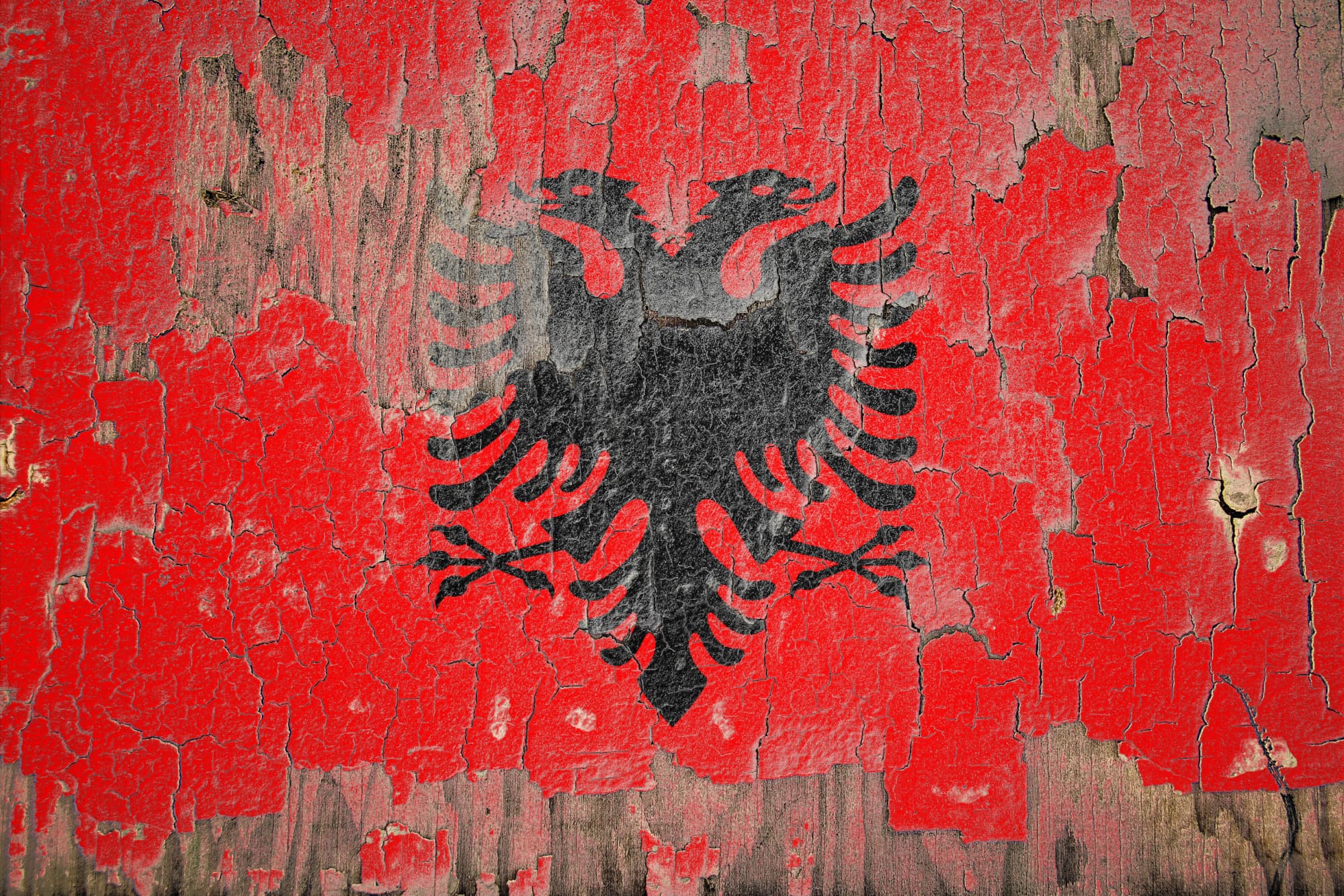
Recent scenes in Tirana resemble a low-budget action film, its thrill long exhausted by repetition and sheer lack of imagination, much like the Democratic Party of Albania (DP), which, after committing political suicide iterum atque iterum, has selected Molotov cocktails and atmospheric smoke effects as its preferred survival strategy.
For roughly two months, the opposition has maintained a violent presence in the public space and succeeded in attracting international attention . However, what has widely been described as merely “anti-corruption” or “anti-government” protests in Albania, in reality amounts to the instrumentalization of the anti-corruption cause by the “historic opposition”in an attempt toreclaim legitimacy and lost political relevance. The situation is far from black and white, given the multiplicity of actors and interests involved.
Since 8 December 2025, demonstrators have blocked the entrance to the Office of the Prime Minister following corruption allegations against former Deputy Prime Minister and Minister of Energy and Infrastructure Belinda Balluku. The Special Structure Against Corruption and Organized Crime (SPAK) has indicted her on charges of manipulating public procurement procedures during her tenure as Minister of Energy and Infrastructure.
In November 2025, SPAK interrogated Balluku and subsequently imposed a travel restriction preventing her from leaving the country. In recent years, several of Edi Rama’s ministers and close associates have faced serious corruption allegations or imprisonment, including former Deputy Prime Minister and Minister of Finance Arben Ahmetaj , former Minister of Internal Affairs Saimir Tahiri , former Minister of Health and Social Protection Ilir Beqaj , and even the current Socialist Mayor of Tirana, Erion Veliaj to name a few.
Last Thursday, amid mounting external pressure and growing domestic criticism, Rama dismissed seven members of his cabinet, including Balluku. The decision follows months of sustained public attacks by Rama on Albania’s judicial institutions , as well as his refusal to initiate parliamentary procedures to lift Balluku’s immunity at SPAK’s request , a step that would allow prosecutors to proceed with her arrest. Following these developments, the matter of her immunity is set to be put to a parliamentary vote on March 5.
This cabinet reshuffle comes only six months after the government was formed following the May 2025 elections . Since first assuming office in 2013, Rama has consistently reorganized his cabinet before the completion of each governing term. As a result, ministers operate within a climate of permanent replaceability, a condition that privileges vertical loyalty over autonomous political agency and consolidates executive control. Over thirteen years in power, ministerial turnover has functioned less as a mechanism of accountability and more as a substitute for structural reform: responsibility is individualized and displaced onto officeholders, while the core decision-making architecture of the executive remains fundamentally unchanged.
Despite the legitimacy of the anti-corruption cause and rising public trust in institutions such as SPAK ,established under the 2016 justice reform, the current anti-government protests have struggled to secure broad-based support. The problem residesless inwhatis being demanded than in whois demanding it.
The first mobilization came from the newly formed center-right party Albania Becomes, led by lawyer and former civil society activist Adriatik Lapaj, which staged sit-ins outside the Prime Minister’s Office after Balluku was summoned by SPAK. The party’s political credibility eroded rapidly following an internal dispute between Lapaj and his coalition partner Endri Shabani (now Albania’s Ombudsman) over the single parliamentary seat won by their joint electoral list, the Albania Becomes Initiative, in last May’s elections.
During the campaign, the coalition pledged to reject Albania’s closed-list system, under which party leaders, rather than voters, determine which candidates enter parliament, by symbolically placing fictitious names on the closed portion of the list and competing only through open-list votes, which they framed as more democratic.In reality, however, the closed list was neither withdrawn nor invalidated. Ultimately, the sole parliamentary mandate was allocated through the closed list to a relative of Lapaj, rather than to Lapajor Shabani, both of whom had received individual votes.
Having lost political credibility at the outset of his career, especially after presenting himself as the embodiment of a new and ethically differentiated mode of political practice, Lapaj now appears to be using the anti-corruption protests less as a principled stance and more as an attempt at public rehabilitation.
On the other hand, the DP, a cartel-party currently resembling a cadaver in Albania’s contemporary political landscape, and its long-time leader Sali Berisha, appear willing to deploy every available strategy to regain visibility and return to power: from embracing far-right, often Trumpist, rhetoric, to selectively appropriating historical legacies, including the party’s role in the student protests that precipitated the collapse of Albania’s socialist regime in 1991. For example, the latest protest was strategically staged on February 20, a date symbolically linked to the 1991 toppling of Enver Hoxha’s statue, and it culminated in DP supporters setting fire to Hoxha’s former residence , currently used as an artistic venue, despite the presence of people inside at the time of the assault.
Since its 2013 electoral defeat, driven not only by growing authoritarianism at the time but also by two defining political crises, the DP has entered a phase of structural decomposition. The first was the explosion at a former military ammunition depot in Gërdec in 2008 , a village 20 kilometers north of Tirana, where the illegal arms-dismantling operations killed dozens and injured hundreds, exposing the entanglement of state authority with private gain, amid widespread allegations connecting Berisha, members of his family, and close associates in the to the networks and business interests underpinning the operation.
The second was the 2011 killing of four protesters during an opposition demonstration outside the Prime Minister’s Office , carried out under the authority of the Prime Minister’s Office during Berisha’s second term in power. These crises, compounded by successive political scandals and persistent allegations of corruption, did not only damage the DP’s electoral standing; they undermined its institutional coherence and moral authority. Rather than undertaking substantive structural reform in their aftermath, the party descended into internal schism and has since remained captive to Berisha’s authoritarian leadership.
Therefore, the DP seeks to sustain itself by feeding off the reactive causes of other political movements, attempting to co-opt and subsume them for its own survival. Although the protests were primarily initiated by Lapaj’s party, the DP gradually absorbed and ultimately overshadowed the mobilization, transforming what began as a smaller-scale initiative into a platform for its own political resurgence.
What is unfolding on the streets of Tirana, therefore, is less a “people versus Rama” scenario, but rather Berisha protesting the corruption he can personally no longer carry out—right after having been released from house arrest on corruption charges himself.
In this sense, both Berisha and Lapaj are engaged in a strategic contest over the ownership of the anti-corruption agenda. Yet, Lapaj attempts to preserve the image of autonomy, aware of the reputational risks of overt alignment with the DP, while simultaneously benefiting from the latter’s superior organizational infrastructure and mobilizational capacity. However the boundary between strategic distance and tacit alignment remains blurred. Nonetheless, each needs the other, and both appear willing to make significant compromises in pursuit of renewed political leverage.
Thus far, the authorities have responded by making several arrests of protesters, mainly inconnection with the use of pyrotechnics. However, these protests do not constitute a systemic threat for at least two reasons. First, both the DP and Lapaj lack broad societal credibility and are viewed with considerable skepticism by significant segments of the electorate, which limits their capacity to transform episodic mobilization into prolonged political momentum. Second, the ruling Socialist Party (SP) retains extensive control over key state institutions, giving it structural advantages that protect it from short-term instability and limit the opposition’s capacity to drive institutional change.
In contrast to Serbia, where anti-government protests developed organically from grassroots mobilization which converted collective rage into sustained political mobilization over the past year, the protests in Albania lack comparable social anchoring. Rather than reflecting a broad-based civic uprising, they arelargely driven by established political actors seeking to reposition themselves within the existing power structure. As a result, what appears on the surface as anti-government mobilization is better understood aselite-mediated dispute, constrained by the very actors who claim to represent it.