Politicians, analysts and journalists are increasingly advocating for some form of lower-tier EU membership for candidate countries from Southeast and Eastern Europe. Such musings about delaying full membership distract from understanding the fundamental issues.
The key fact is that countries aspiring to join the EU are transfering vast wealth to Western Europe. This hold back their social and economic development.
In essence, the six economies of Southeast Europe (SEE6)[1] contribute to maintaining the EU’s standard of living and the competitiveness of its economy in the global market. But on the other hand, current arrangements with the EU do not provide the SEE6 group with the opportunity to even approach the EU’s average level of development.
This is mainly due to trade deficits, debt repayment and the provision of cheap labor to EU companies. However, the most significant factor is the loss of human capital.
Between 2021 and 2024, nearly one million citizens of the region received their first residence permit for more than three months in the EU. They emigrated to the EU for employment, family reunification, education, or other reasons (some seeking political asylum to remain in the EU).
Number of first residence permits issued in the EU to SEE6 citizens, by year:
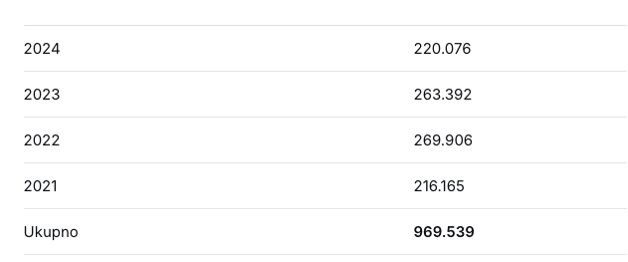
Source: First permits by reason, length of validity and citizenship [migr_resfirst__custom_20683841]
Immigrants from Albania and Kosovo make up around half of the total number.
Similarly high number of immigrants from SEE6 to the EU were recorded before the COVID-19 outbreak. Only during the pandemic in 2020 was there a brief slowdown in migration from SEE6 to the Union. Data for 2024 suggests that migration from the region to the EU may have peaked, likely because human capital reserves in SEE6 are nearly exhausted. According to World Bank forecasts, over the next five years, if current demographic, economic growth, and labour market trends continue, the region could face a shortage of 190,000 workers.[2]
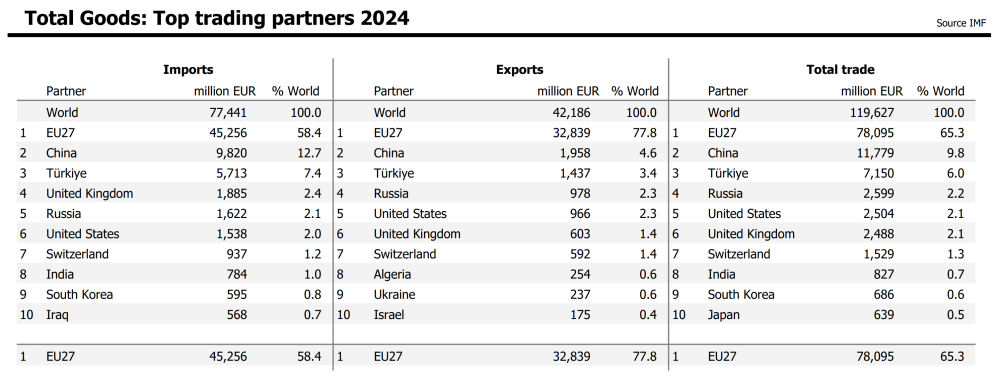
Source: EC, DG Trade, European Union, Trade in goods with the Western Balkans
In 2024, the EU accounted for 65.3% of SEE6’s total trade with the rest of the world.
Relations between SEE6 and the EU are mainly regulated by Stabilisation and Association Agreements (SAAs) signed in the last decade and before. These were intended to be temporary until the region formally joined the EU. However, they have become a permanent fixture. For almost all candidates from Southeast and Eastern Europe, it is uncertain whether they will ever join the Union.
Even before signing SAAs with the EU, SEE6 countries were rapidly integrated into EU value chains, primarily of German origin. Today, a significant portion of trade consists of intermediary products moving within the value chains of EU companies. They opened production facilities in SEE6 due to a combination of geographical proximity, cheap labour, tax incentives, high state subsidies, weak enforcement of environmental and labour regulations, and other investment incentives. Most foreign direct investment went into low value-added, labour-intensive sectors.
Between 2014 and 2024, the Western Balkans had a trade deficit with the EU of nearly €102 billion. In the earlier decade, the trade deficit was also approximately €100 billion.
SAAs abolished tariffs on almost all goods exchanged between the EU and SEE6, opening the door to EU products, including highly subsidized agricultural goods. Many local industries were left unprotected from EU competition and most lacked the means to invest in modernization. Domestic production was unable to compete with powerful new competitors.
However, unlike new EU member states in Central Europe, SEE6 countries did not gain access to EU structural and cohesion funds or other free capital to stimulate economic and social development. EU aid to SEE6 through the Instrument for Pre-Accession Assistance and the Growth Plan amounts to roughly one-tenth of what EU member states in the region receive from Brussels. As a result, SEE6’s trade deficit with the EU continues to grow, while GDP growth stays below the level needed to quickly catch up with the EU average.[3]
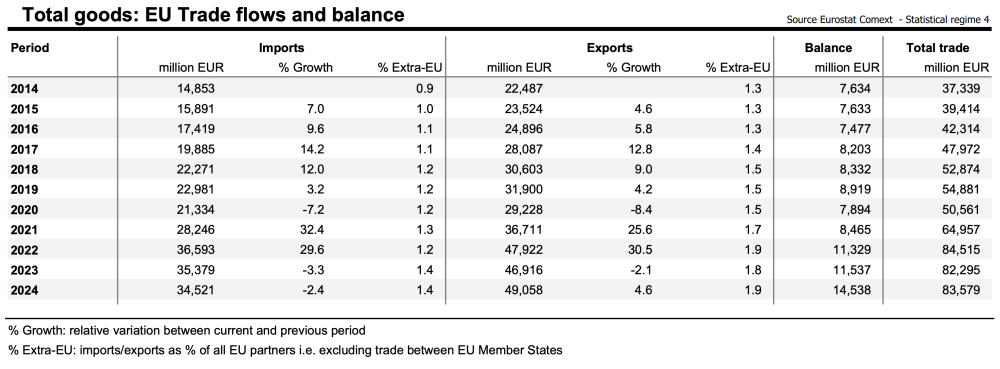
Serbia accounts for about 50% of the trade in goods between the EU and the Western Balkans and has the largest trade deficit
|
Category |
Value (€ billion) |
|
Total trade in services |
18.2 |
|
EU exports to Western Balkans |
8.2 |
|
EU imports from Western Balkans |
10.0 |
Source: https://www.consilium.europa.eu/en/infographics/eu-western-balkans-investment-and-trade/
Over the past decade, trade in services (such as transport, tourism, and IT services) between the EU and the Western Balkans has more than doubled (+113%). Cheap IT services provided by highly qualified personnel in SEE6 are the main source of surplus. Serbia accounts for 44% of the EU’s trade in services with the Western Balkans.
The CONVERGE2.EU research group, led by the Vienna Institute for International Economic Studies (WiiW), developed a series of scenarios in 2025 on how relations between SEE6 and the Union might evolve. For Serbia, which has the largest population and economy in SEE6, it will take 29 years to reach the EU’s average GDP per capita if nothing changes. If Serbia had access to the EU budget, it would take 21 years. If it became a full EU member, it would take 18 years. Similar forecasts apply to the rest of the SEE6 group.
[1] SEE6 are the economies of Serbia, Kosovo, North Macedonia, Albania, Montenegro and Bosnia and Hercegovina.
[3] C.f. Matteo Bonomi, Integrating the Western Balkans with the EU economy: New Plan, Old Problems. In Structural Change in the Western Balkans,.Mildner, Bories, Shapiro (eds.) Aspen Institute Germany 2025 https://www.aspeninstitute.de/wp-content/uploads/Structural-Change-in-the-Western-Balkans.pdf
Also:
Dušan Reljić, Expansion, Not Enlarement; Südosteuropa Mitteilungen 06/23, p.41-49, München 2023