Political culture largely determines what kind of public debate a society can have, and what consequences that debate entails. Discussions conducted within an autocratic political culture differ fundamentally from those taking place in a democratic one. Above all, the consequences of engaging in open discussion differ fundamentally between the two. An autocratic political culture is founded upon fear and coercion, reflecting the need to suppress pluralism and eliminate political alternatives. In such circumstances, sensitive issues of collective identity become instruments of political confrontation.
In contemporary Serbia under the regime of Aleksandar Vučić, discussing topics such as the Srebrenica genocide carries significant personal and professional risks. Individuals who address this issue are routinely portrayed as traitors and enemies, effectively legitimizing them as targets of public vilification. At times, these actors themselves become instruments in broader political strategies. They are deliberately associated with political alternatives, such as the student movement, in order to stigmatize the movement through accusations of treason.
A defining characteristic of autocratic rule is the absence of public space as an autonomous institution. Owing to government control over key media outlets and the extreme polarization of the political arena, meaningful discussion of topics requiring critical reflection and the exchange of arguments becomes virtually impossible. There is no public platform on which such conversations can genuinely occur. At the same time, attempts to raise these issues often appear almost grotesque. Discussing events that occurred three decades ago at times of heightened state repression, police brutality and normalization of violence against peaceful protesters places anyone wishing to address the past in an inherently uncomfortable position.
During Serbia's period of fragile democracy between 2000 and 2012, Srebrenica was, in fact, publicly discussed. The debate was neither sufficiently comprehensive nor particularly courageous, but it nevertheless existed. Democratic governments did not promote a single, unified narrative about Srebrenica, nor were they capable of presenting any interpretation as the only legitimate and unquestionable one. At the very least, they generally refrained from denying the crime itself, instead contesting only its legal qualification as genocide – a position that was met with strong criticism from human rights activists and segments of the political opposition. At the time, public prosecutors specializing in war crimes also played an important role in the public sphere, frequently speaking about Srebrenica and related issues. During the administration of the assassinated Prime Minister Zoran Đinđić, Serbia's public broadcaster aired the Dutch documentary A Cry from the Grave, prompting an intense public debate.
Virtually all of these developments disappeared after 2012. Within the autocratic political culture established by Aleksandar Vučić, Srebrenica has become one of several petrified national myths that are neither questioned nor openly discussed. The central premise of this myth is that Srebrenica serves as a political instrument wielded by the international community against Serbia and Republika Srpska. Within the official narrative promoted by Vučić's government, the president presents himself as the defender of Serbian national interests against threats posed by neighboring states and major international powers. One manifestation of this alleged threat is the supposed effort to label the Serbian people as a “genocidal nation.”
Consequently, the only sustained public campaign concerning Srebrenica focuses precisely on this alleged international conspiracy against the Serbian people. Conducted under the slogan "Serbs Are Not a Genocidal Nation," it implicitly suggests that Western actors claim the opposite. All other discussions about Srebrenica – including conspiracy theories concerning the roles of the British, French, or Croats, claims about allegedly falsely buried victims, or assertions that Bosniaks killed one another – have been pushed to the margins of the internet, particularly YouTube, and remain largely absent from mainstream media. Within the dominant media landscape, the only acceptable narrative is the official state narrative, in which the actual events in Srebrenica are largely irrelevant. What matters instead is the portrayal of any discussion of the genocide as part of an anti-Serbian conspiracy, against which, supposedly, only the firm leadership of the incumbent president can provide protection.
As part of its instrumentalization of the Srebrenica genocide, the Serbian government also uses the issue to reinforce its broader anti-Western and anti-European political campaign. Owing to Serbia's geopolitical position, the authorities cannot openly reject the country's formal objective of European Union membership. At the same time, they recognize that autocratic governance is fundamentally incompatible with the democratic principles upon which the European Union is founded. Consequently, criticisms originating from the European Union – although regrettably infrequent – are likewise portrayed as components of a broader Western effort to undermine Serbia, including by allegedly branding the Serbian people as genocidal. Meanwhile, the European Union has largely adopted a conciliatory approach consistent with the logic of “stabilitocracy”, paying relatively little attention to questions of democratic values. The result is a paradoxical situation in which the Serbian government accuses the European Union of using Srebrenica as an instrument of political blackmail far more frequently than the EU itself raises the issue in the context of Serbia's accession process.
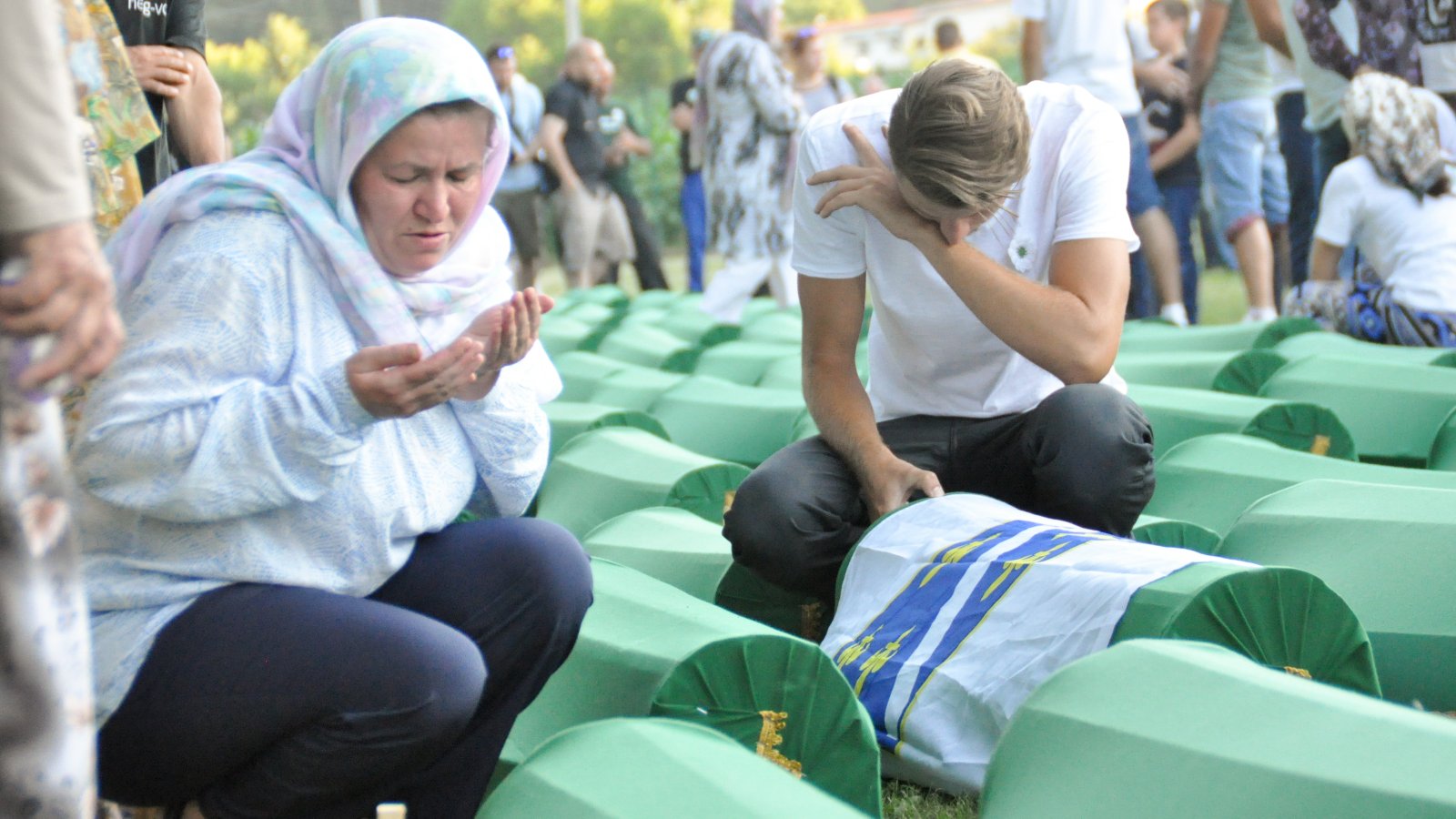
The victims of the Srebrenica genocide and their families deserve recognition, respect, and, above all, freedom from the continued reopening of their wounds through the denial of the crimes committed against them. Such conditions can emerge only through the restoration of democracy in Serbia. Even then, the path toward truth, acknowledgment, and acceptance of responsibility will be neither simple nor straightforward. Nevertheless, democracy would at least make it possible for competing narratives to be presented publicly and for citizens to learn the established facts. Even the weakest democratic government provides a far healthier environment for the victims of war crimes and for regional reconciliation than any autocratic regime. In the field of dealing with the past, as in every other aspect of public life, the old saying once again proves true: democracies have a thousand flaws, whereas autocracies have only one – they are not democracies.
Photo: Samir Beharić, Srebrenica Genocide Commemoration, 2015