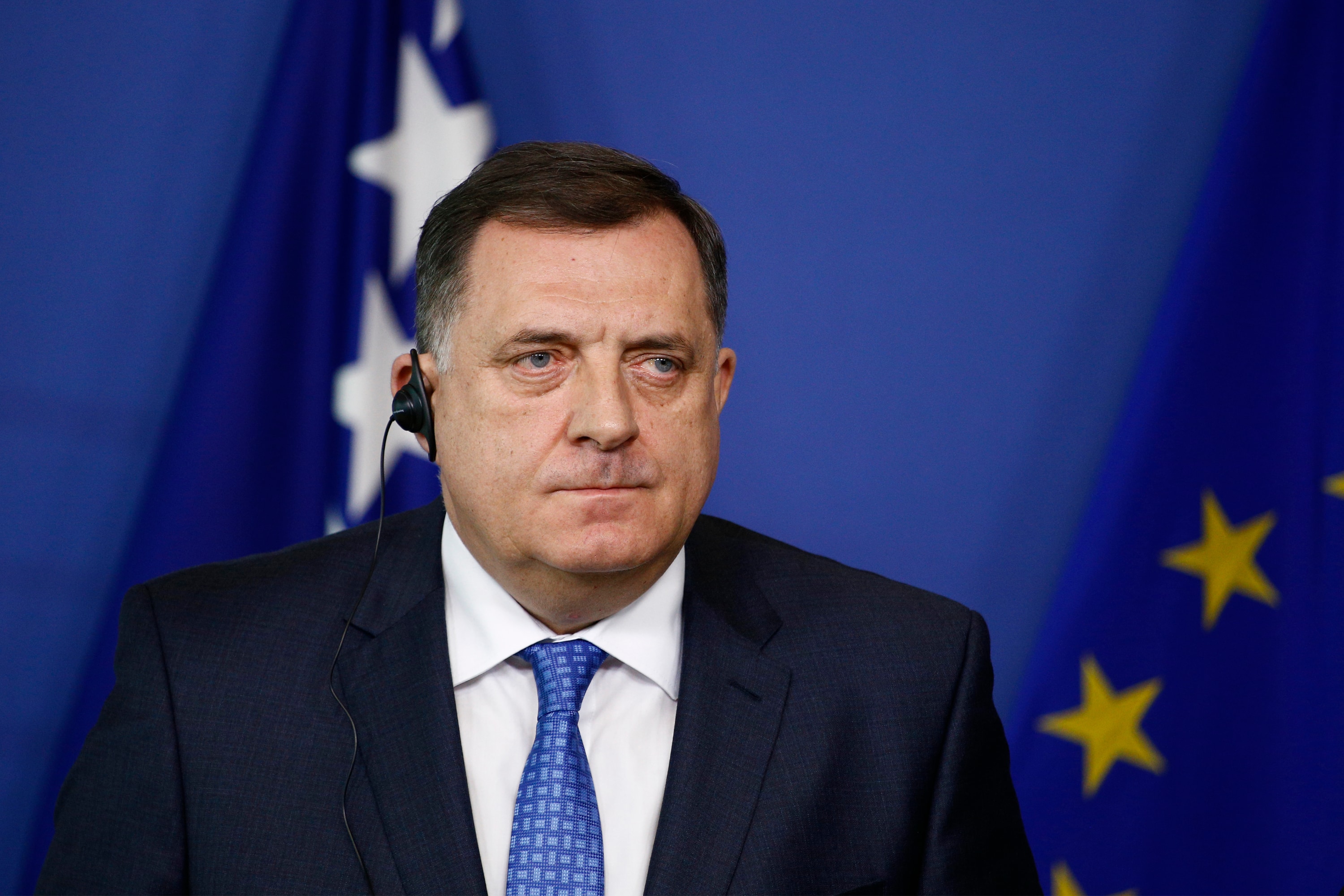
Imagine going – in a span of months – from being on the sanctions list of the US Department of the Treasury for “threatening territorial integrity of Bosnia and Herzegovina” to shaking hands with US policymakers at the State Department, while proudly reiterating the same nationalist slogans.
That is exactly where the success of Milorad Dodik’s propaganda lies. And this was made possible by the US Office of Foreign Assets Control (OFAC) which suddenly removed sanctions against the Bosnian Serb leader in October 2025. Such a decision may not mean a shift in US foreign policy toward Bosnia and Herzegovina, but it is highly symbolic. And symbolism in Balkan politics carries great weight. Removing Dodik and his aides from the sanctions list because of “the constructive actions taken by the Republika Srpska National Assembly” amounts to a de facto political legitimation of the destructive laws adopted by that assembly in February 2025 to dismantle the Dayton Peace Accords. Two elements render the US geopolitically inconsistent. First, Washington is disregarding the peace accords its diplomats promoted thirty years ago – an agreement that, despite all its imperfections, can still be considered the best diplomatic achievement in the region in decades. Secondly, the US is rehabilitating one of Europe’s closest political supporters of Russian President Vladimir Putin.
From Dodik’s perspective, there is not the same level of inconsistency; the former president of Republika Srpska is just maximizing his international support, aligning both with Putin’s Russia and Trump’s administration. Thus, Dodik’s visit to Washington does not signal a change in US foreign policy – the Balkans will most probably remain of secondary importance – rather, it stands as a triumphant showcase for his politics. Moreover, the new war in the Gulf is making the world increasingly unstable, undermining respect for international law and emboldening those authoritarian leaders who may exploit chaos to pursue their destructive agendas.
Dodik’s rehabilitation
Even if Milorad Dodik did not personally meet with the US President, last February’s visit was mainly meant as a tribute to Donald Trump. And although Dodik, the Serb member of the Bosnian Presidency Željka Cvijanović, and the acting president of the Republika Srpska Ana Trišić Babić went to Washington in a personal capacity, it was their first visit to the US in 15 years. There they met with several key people within Trump’s administration, including the Speaker of the House of Representatives, Mike Johnson, the Secretary of War, Pete Hegseth, and White House Press Secretary Karoline Leavitt, as well as some Republican congressmen. After that, they attended the National Prayer Breakfast: the event gave Dodik the opportunity to revive the nationalist rhetoric according to which Serbs back in the 1990s had defended Christendom and Europeans from radical Islam. The Bosnian Serb leader knows that the protection of persecuted Christians is one of the main pillars of Trump’s second term, as last December US forces carried out strikes in north-western Nigeria, where Trump described the situation as a “genocide” against Christians.
“The Muslims [of Bosnia and Herzegovina] are collaborators of Iran and they are strong opponents of Israel and Jews. During the Second World War they sided with Hitler, and they organized concentration camps for my people. A grim peculiarity of that time is that they organized concentration camps for children. Children were separated from their mothers and sent to the camps. 45,000 children died in those camps” – this is one of the propaganda narratives Dodik told Lindell.tv, where he looked for sympathy from an audience that in a span of weeks went on to witness US and Israeli aggression against the Islamic Republic of Iran. Another window for propaganda was offered by an editorial in the conservative Washington Times titled “Republika Srpska Deserves Independence”, which echoed Dodik’s propagandistic and Islamophobic claims.
The Bosnian Serb politicians thus secured a political victory on various fronts: the rehabilitation of their politics, that came as a last-minute electoral boost for Siniša Karan, Dodik’s loyalist who that very weekend won the early presidential vote in Republika Srpska; but also, Washington’s de facto acceptance of Dodik’s pro-Russian stance – which now coexists with his support for the US and Israel in their war against Iran.
Will the US still guarantee peace?
Dodik’s nationalism – made up of secessionist threats, Islamophobia, and pro-Russian sentiment – aligns neatly with Trump’s political rhetoric – consisting of war threats, xenophobia, and growing anti-European sentiment. In a certain sense, Dodik is the Balkan ambassador of Trump, the latter globally seen as the leader of the far-right sovereigntist international.
What matters here is whether the US will be able to guarantee the Dayton peace order, which it shaped thirty years ago. Interviewed by the Financial Times, Dodik said the Accords were unsalvageable and he railed against High Representative Christian Schmidt, who oversees the implementation of the agreement, claiming that he had “no legitimacy” in Bosnia – a claim Russia has been repeating at the UN Security Council since the German diplomat began his mandate.
So far, what mainly contributed to Dodik’s fortune within Trump’s inner circle has been the millions spent on lobbying. According to the Foreign Agents Registration Act (FARA), there are 17 registered entities from Bosnia and Herzegovina that lobby in the USA, 15 of which work in the interest of Republika Srpska. Among them is Dickens & Madson Canada Inc, led by Israeli-Canadian lobbyist Ari-Ben Menashe. In the contract signed in September 2025, the agency states “the independence of Republika Srpska from Bosnia and Herzegovina is our ultimate goal”. The contract, worth $2 million, sparked controversy and leda group of representatives to file a criminal complaint with the BiH Prosecutor’s Office. As Detektor reports, member of the House of Representatives of the Parliamentary Assembly of Bosnia and Herzegovina Saša Magazinović claimed that entity representative offices did not have the authority to conduct foreign policy and that there were suspicions of illegal spending of budget funds. However, that seems to be a minor problem. Only one month after signing the contract, the lobbying firm secured the revocation of OFAC sanctions against Milorad Dodik, his family, his assets and aides. And activities on behalf of Republika Srpska would continue. At the beginning of 2026, Banja Luka authorities signed a new contract with the company Lucas Compton LLC, with the aim of lobbying the US administration, Congress, the media and the public. Furthermore – as a Detektor investigation reveals – Republika Srpska renewed a one-year collaboration with McGinnis Lochridge LLP worth $1.8 million, in order to “provide advice in the field of ‘the rights and obligations of the Republic of Srpska and Bosnia and Herzegovina under the Dayton Agreement,’ as well as relations with international organizations such as the UN, OSCE, the EU, and the Council of Europe.”
The company will also work on contacting US officials, members of Congress, and agencies regarding issues relevant to the Republika Srpska and Bosnia and Herzegovina, as well as conducting communication campaigns.
It is hard to foresee what the ultimate result of such lobbying activities will be in the Balkans, as the war in the Gulf will keep the region at the margins of US foreign policy. However, Republika Srpska has already succeeded in rehabilitating its leader as well as his secessionist ambitions, and in securing a welcome among US politicians and lawmakers. While Washington may not change its approach toward Bosnian affairs, Republika Srpska authorities will soon resume their secessionist activities. A crucial moment will occur in October, at the next general elections, which could mark the first time since the end of the war that a Bosnian Serb nationalist leader will enjoy both Kremlin and White House political endorsement.
The main hope in Banja Luka is that the emerging new world order envisioned by the current US administration – one marked by a drift toward anarchy, a disregard for international law, and the replacement of the United Nations with an elitist, Trump-owned “Board of Peace” – could indirectly legitimize not only authoritarian leaders worldwide but also their secessionist agendas.