More than sixty years ago, Robert Dahl posed a deceptively simple question: Who governs? His inquiry was not merely about who holds office, but about how power is exercised, who benefits from political decisions, and how citizens can hold decision-makers accountable.
Today, that question feels newly urgent across the Western Balkans. Not because citizens are necessarily questioning who formally holds power, but because they are questioning how power is exercised.
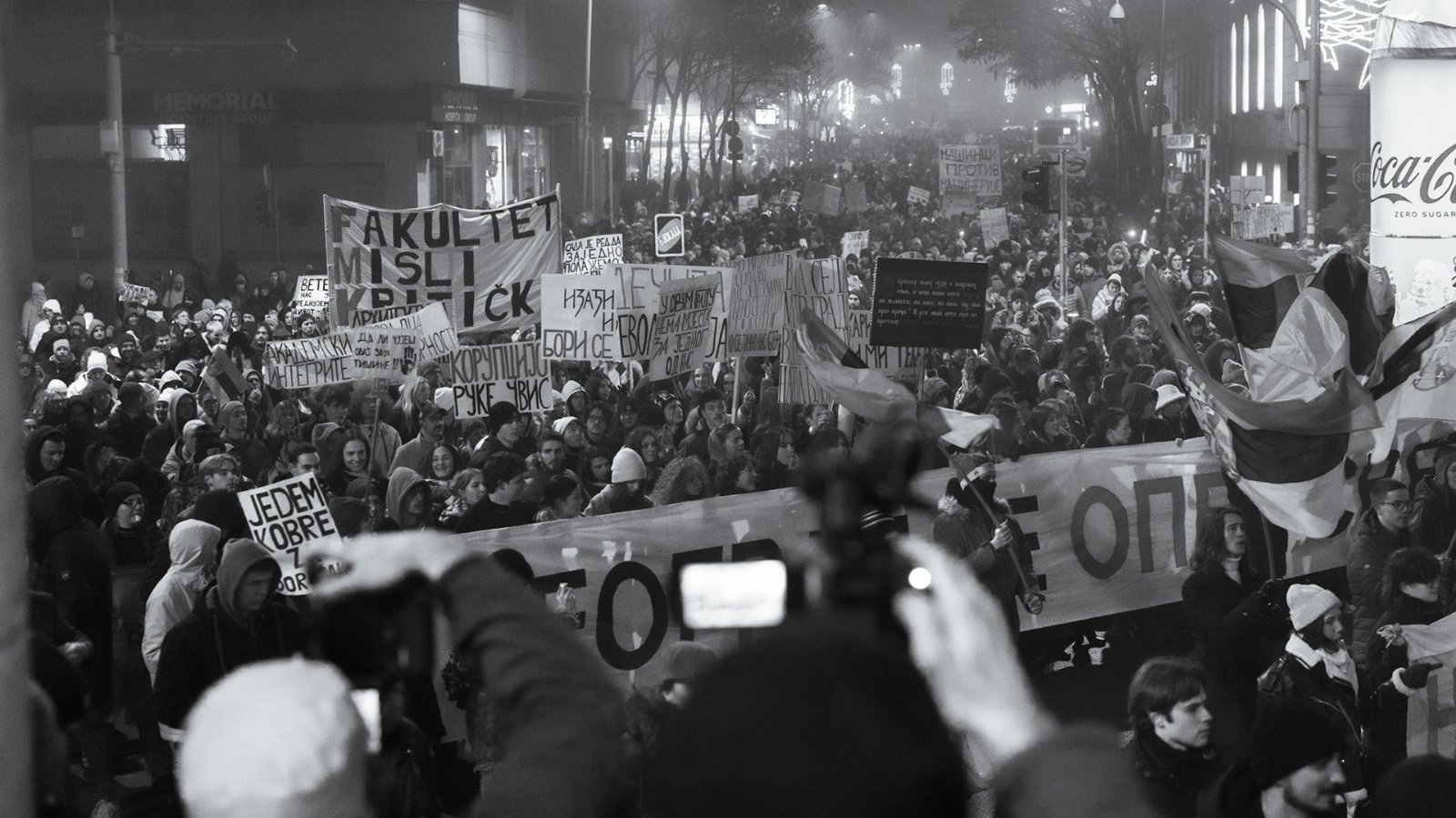
From the protests that followed the collapse of the railway station canopy in Novi Sad in November 2024 to the mobilisation against the proposed luxury resort in Albania’s protected Zvërnec–Narta area in 2026, some of the region’s most significant civic movements have revolved around remarkably similar concerns. Citizens are asking who makes decisions, whose interests are being served, whether institutions are functioning properly, and who bears responsibility when they fail. Earlier environmental protests against the proposed Rio Tinto lithium project in Serbia similarly evolved into broader debates about public consultation, institutional trust, and political accountability.
At first glance, these cases appear unrelated. One was triggered by a tragic infrastructure disaster, another by concerns over environmental protection and public land. Yet both quickly evolved into broader debates about transparency, public oversight, institutional responsibility, and the limits of executive power.
Elsewhere, the specific triggers have differed, but the underlying concerns are strikingly similar. In Montenegro, public debates surrounding institutional reform and corruption have repeatedly centred on the credibility of state institutions and the rule of law. In North Macedonia, civic mobilisation has frequently highlighted concerns regarding corruption, accountability, and public trust. In Kosovo, debates over governance performance and institutional responsiveness have become more prominent within broader discussions about democratic consolidation.
Equally important, these mobilisations are not entirely isolated from one another. Citizens across the region increasingly observe and learn from one another. The anti-corruption protests in North Macedonia, environmental campaigns against small hydropower projects in Bosnia and Herzegovina, civic mobilisation in Serbia, and recent demonstrations in Albania are rooted in different national contexts, yet they contribute to a shared regional conversation about governance, accountability, and democratic responsiveness. This does not imply the existence of a common movement. It does, however, suggest the emergence of common democratic expectations across the Western Balkans.
|
Accountability Mobilisations across the Western Balkans Civic mobilisation in the Western Balkans has evolved alongside the region’s political transformation. During the early post-socialist and post-conflict period, political contestation was shaped primarily by regime change, statehood, ethnic relations, reconstruction and geopolitical orientation. During the following decade, corruption, democratic backsliding, media control and state capture became increasingly prominent sources of public dissatisfaction. More recent mobilisations often begin with a concrete project, disaster or institutional failure, but develop into broader demands concerning transparency, public consultation, institutional responsibility and accountable government. Serbia. In Serbia, environmental mobilisation against the proposed Rio Tinto lithium project expanded beyond ecological concerns to questions of public consultation, decision-making and institutional trust. Following the November 2024 collapse of the Novi Sad railway-station canopy, public grief similarly developed into a nationwide demand for transparency, institutional responsibility and political accountability. Albania. In Albania, opposition to the proposed luxury development in the protected Zvërnec–Narta area brought together environmental protection, public-land governance, property rights and demands for transparency. The mobilisation increasingly questioned not only the project itself, but also the procedures through which major investment decisions are authorised and justified. Bosnia and Herzegovina. In Bosnia and Herzegovina, campaigns against small hydropower projects have connected local environmental struggles with broader concerns about the governance of public resources, institutional oversight and citizens’ participation in decisions affecting their communities. North Macedonia. In North Macedonia, the 2015–2016 political crisis and the Colourful Revolution challenged illegal surveillance, political impunity and the abuse of state institutions. The protests following the deadly Kočani nightclub fire in March 2025 renewed these concerns in a different form, transforming public grief into demands for justice, effective regulation and institutional accountability. Montenegro. In Montenegro, dissatisfaction with the concentration of political power, corruption and weak institutional checks developed over several decades. The 2019 “Odupri se – 97,000” movement crystallised these grievances into demands for senior resignations, credible electoral conditions, media freedom and more accountable institutions. Kosovo. Kosovo represents a less consolidated pattern. Since independence, civic mobilisation has developed within a context shaped by state-building, contested sovereignty, international governance and unresolved national questions. Although concerns regarding corruption, public services, consultation and institutional responsiveness are increasingly visible, they have not yet converged into a sustained accountability-centred movement comparable to those found elsewhere in the region. These cases do not represent a single regional movement or an identical political trajectory. They nevertheless reveal a gradual shift in civic contestation: from struggles centred primarily on statehood, regime transformation and identity toward a growing concern with how political authority is exercised, justified and held accountable. |
What this development means for democracy is significant. It suggests that democratic legitimacy in the Western Balkans is increasingly being judged not only by whether elections are held or institutions formally exist, but also by how public authority is exercised between elections. Citizens are demanding access to information, meaningful consultation, institutional responsiveness and identifiable responsibility when public decisions fail. Democracy, in this sense, is being understood less as a periodic electoral procedure and more as a continuous relationship of accountability between institutions and society.
Yet this development should not be interpreted as evidence that democratic consolidation will necessarily follow. Civic mobilisation can expose institutional failures, generate public pressure and redefine the boundaries of legitimate political authority, but it does not automatically create durable mechanisms of accountability. The democratic significance of these movements will ultimately depend on whether their demands are translated into stronger institutions, more transparent procedures, effective oversight and sustained forms of citizen participation.
The significance of these developments therefore lies not only in the scale of protest, but in the gradual transformation of the standards by which political authority is judged.
What do these seemingly diverse developments reveal?
They suggest that governance-related grievances are becoming central to political contestation across the region.
Citizens are not only contesting particular policies. Increasingly, they are contesting the procedures through which those policies are designed, justified, and implemented.
Seen from this perspective, many recent mobilisations are not simply protests against particular governments or projects. Rather, they are expressions of a broader demand for procedural legitimacy and accountable governance.
In this sense, accountability is emerging not merely as a policy issue, but as a democratic principle now organising political mobilisation.
This matters because the dominant political narrative about the Western Balkans remains centred on stability. For much of the past decade, discussions about the region have focused on democratic backsliding, state capture, geopolitical competition, and the phenomenon that Florian Bieber and Marko Kmezić described as stabilitocracy: political systems that formally embrace European integration while simultaneously concentrating power and weakening accountability mechanisms.
This literature remains highly relevant. While stabilitocracy helps explain how political elites have maintained power, recent mobilisations reveal something equally important: how citizens increasingly seek to challenge, constrain, and hold that power accountable.
This does not mean that nationalism, identity politics, or geopolitical competition has disappeared. The Western Balkans remain shaped by unresolved historical disputes, competing national narratives, and external geopolitical pressures. Yet governance-related grievances are becoming an important axis of political contestation alongside these enduring issues.
Seen from this perspective, recent mobilisations may point to an important evolution in the region’s political development.
During the 1990s and early 2000s, political mobilisation in the Western Balkans was largely organised around questions of statehood, post-conflict reconstruction, ethnic relations, and geopolitical orientation. During the 2010s, concerns about democratic backsliding, corruption, and state capture dominated academic and policy discussions.
Today, while these issues remain highly relevant, accountability appears to be emerging as an additional source of democratic legitimacy and political mobilisation.
This does not signal the disappearance of older political cleavages. Rather, it suggests that questions of accountability are being layered onto them.
This shift carries broader implications for how democratic change occurs. Existing scholarship has largely examined how external actors influence domestic politics through conditionality, leverage, and Europeanisation. Yet recent developments suggest that democratic pressure increasingly emerges from society itself. Citizens are not merely responding to European conditionality; they are articulating demands that often mirror the democratic principles the European Union seeks to promote. Rather than rejecting Europeanisation, they appear to be demanding a deeper and more substantive version of it.
This observation is particularly important at a moment when enlargement has returned to the centre of European politics. Following Russia’s full-scale invasion of Ukraine, the European Union has rediscovered enlargement as a geopolitical necessity. Candidate countries that only a few years ago appeared trapped in an uncertain accession process have once again moved to the centre of European strategic thinking.
Yet a paradox emerges. While policymakers increasingly approach the Western Balkans through a geopolitical lens, many citizens are turning their attention to governance. The future success of enlargement may therefore depend not only on whether candidate countries move closer to the European Union, but also on whether citizens perceive that European integration contributes to more accountable governance at home.
The challenge facing the European Union is not to choose between geopolitics and democracy. Rather, it is to ensure that geopolitical enlargement remains anchored in democratic credibility.
The Western Balkans are often discussed as a geopolitical space. Recent developments suggest they should also be understood as a democratic laboratory, where citizens are acting as producers of democratic demands rather than passive recipients of reform agendas.
Dahl’s question therefore remains highly relevant. The central issue is no longer simply who governs. It is whether political authority can remain legitimate without accountability.
Image credits: https://protesti.pics