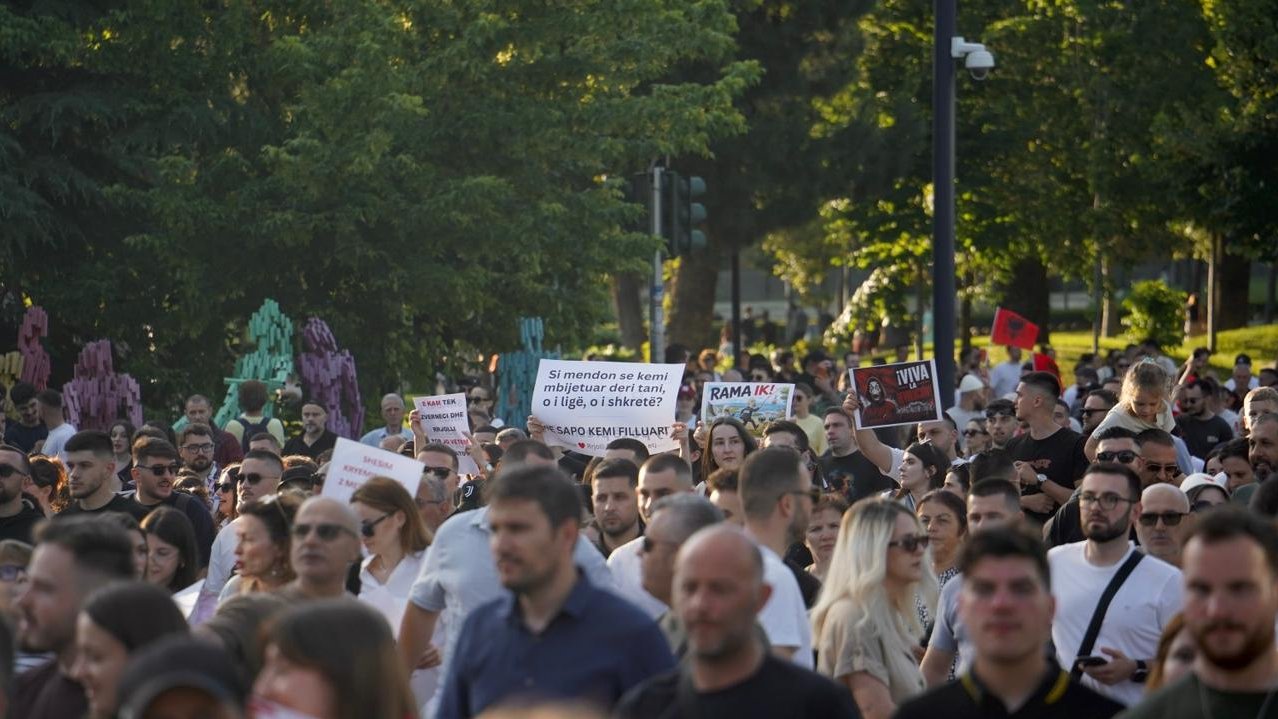
On 20 June, the twenty first consecutive day of protests in Albania, an estimated few hundred thousand people gathered in Tirana in what has become the largest civic mobilization in the country’s post-communist history. What began as a localized protest against proposed development projects in the Zvernec–Narta protected area, reportedly linked to investments associated with Jared Kushner and interests connected to U.S. President Donald Trump, has evolved into a broader expression of public dissatisfaction with corruption, governance, and state accountability. Increasingly, protesters have directed their demands toward Prime Minister Edi Rama, calling for his resignation and fundamental political change.
Notably, for now, the movement has remained largely non-partisan. It has neither produced a clear leadership structure nor become affiliated with existing political parties. Instead, it is widely perceived as a spontaneous civic uprising, organized through informal networks and driven by a growing sense of frustration among citizens who feel excluded from meaningful political influence.
The protests in Albania reflect a wider trend emerging across the Western Balkans. In Serbia, student demonstrations have persisted for nearly two years, mobilizing large sections of society around demands for accountability, transparency, and democratic reform. North Macedonia has witnessed periodic protests over issues related to ethnic relations and the use of the Albanian language, as well as state accountability in the wake of the Kocani nightclub fire, in which 63 people died amid allegations of corrupt licensing and official negligence. Across the region, citizens appear increasingly willing to take grievances directly to the streets rather than rely solely on institutional political channels.
While much attention has focused on public anger directed at governments, these protests reveal another equally important phenomenon: the growing loss of confidence in political opposition parties. Across much of the Western Balkans, opposition forces have struggled to convince voters that they represent a credible alternative to entrenched governing elites. As a result, many citizens increasingly question whether elections and conventional political processes remain capable of delivering meaningful change.
Albania provides a particularly illustrative example. Edi Rama has governed the country for thirteen years. During this period, Albania has achieved notable successes. It has advanced significantly on its path toward European Union membership, emerging as one of the frontrunners among Western Balkan candidates. The economy has expanded, infrastructure has improved, and tourism has experienced extraordinary growth, transforming large parts of the country and becoming a major driver of economic activity.
Yet these achievements have been accompanied by persistent concerns about corruption and state capture. At the time of writing, a former President of Albania and a former Mayor of Tirana are in prison. Several former ministers have been indicted or are under investigation, while others have reportedly left the country to avoid prosecution. Despite these scandals, repeated electoral victories by the ruling Socialist Party have steadily weakened and fragmented the opposition, leaving many Albanians without a convincing political alternative.
A similar dynamic can be observed in Serbia. President Aleksandar Vučić has dominated Serbian politics for nearly fifteen years. Throughout this period, allegations of corruption, pressure on independent media, democratic backsliding, and restrictions on political competition have been recurring themes in both domestic and international assessments of Serbian governance. Nevertheless, opposition parties have struggled to build the organizational strength, unity, and public trust necessary to challenge the ruling establishment effectively.
The result in both countries is a political environment in which democratic competition formally exists but functions under increasingly unequal conditions. Elections continue to take place, opposition parties are legally permitted to compete, and democratic institutions remain in operation. However, governing parties enjoy substantial structural advantages. These often include privileged access to media coverage, extensive use of state resources during election campaigns, politicized public employment, and the allocation of public contracts to businesses closely connected to ruling elites.
In North Macedonia and in Kosovo, too, the situation is far from stable. The student protests in Skopje have shown that there is still a stubborn resistance to the kind of ethno-nationalist politics that VMRO DPMNE (Internal Macedonian Revolutionary Organization – Democratic Party for Macedonian National Unity) has learned to exploit. What is interesting is that the opposition – DUI (Democratic Union for Integration) in particular – has also taken to the streets over holding the bar exam in the Albanian language, backing protests rather than pressing its case through legal or parliamentary channels. This reflects an opposition that has lost its political bearings – much like in Serbia and Albania, where weak opposition structures seem to have ceded the task of confronting their governments to the public. There is something faintly absurd about this, considering that in Albania the protests are calling an end not only to Rama but to the leader of the opposition, Sali Berisha, as well, since he is also seen as part of the problem. This has not stopped Berisha from reposting a photo of the protest, to capture some of the protest’s goodwill on social media.
In Kosovo, the democratic spirit is in dire need of resuscitation. There the opposition and the government have been locked not in the politics of the street, but of the ballot. Unable to define its role under the Kurti government, the opposition has come to see elections as its saving grace – a dynamic that suits Vetëvendosje well, since successive votes have continued to affirm, to different degrees, its legitimacy, even as governance has deteriorated and concerns have grown over the authoritarian use of state resources in the run-up to each round. However, three rounds of elections in less than 15 months have produced voter fatigue. The latest elections had a record low turnout, similar to North Macedonia, opening the fundamental question of legitimacy – are these countries being ruled by the will of the minority? Consequently, the democratic game risks becoming democratic largely in form rather than in substance. Citizens may retain the right to vote, but many increasingly doubt that elections alone can produce genuine political change. The rise of mass civic protests across the Western Balkans may therefore be understood not only as a rejection of incumbent governments but also as a symptom of a deeper crisis of democratic representation. As trust in both governments and opposition parties declines, citizens are increasingly turning to extra-institutional forms of political participation in an effort to make their voices heard.
In the relationship between governments and the governed, there is another player: the European Union. All these countries aspire to be part of the European Union, whether sincerely or merely in name. However, the European Union in the Western Balkan region has a broader meaning having entered the domestic political vernacular as a system of democratic values, which is why the protesters and activists have often looked towards it as a partner in challenging undemocratic practices. As one poster in Tirana read: “Europe, are you listening?” The EU’s credibility as a guarantor of democratic norms is itself being questioned. And yet, it is precisely the protesters who represent the democratic actors capable of making a European future possible for the region, as they embody the EU’s own stated values, and were raised on the EU narrative, and as such they deserve, at the very least, to be heard.
Whether these movements can translate public anger into sustainable political change remains uncertain. What is clear, however, is that they reflect a growing disconnect between formal democratic institutions and the societies they are intended to represent. Rather than defending democratic norms through institutional channels, opposition parties are either disengaging and leaving the burden to citizens, or resorting to tools that sit outside their proper political role and ultimately undermine their own standing. For the Western Balkans, this disconnect may prove to be one of the defining political challenges of the coming decade.
Photo by Davin Çeço, freelance photographer. Takenduring the June rallies in Tirana,2026.