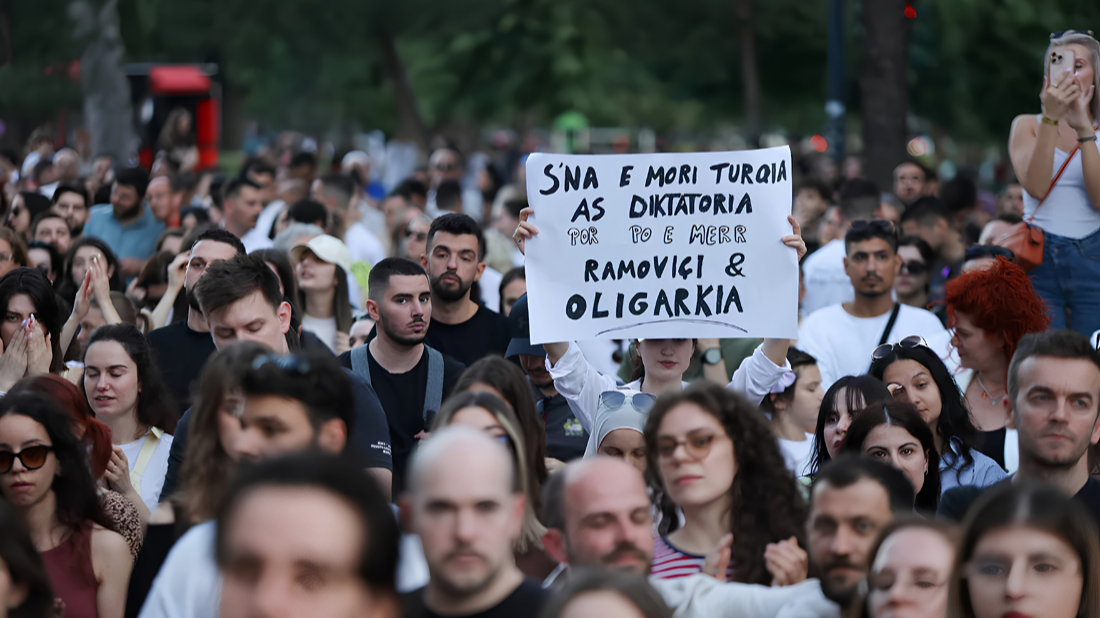
Protests in Tirana against the construction of a luxury resort in the Zvërnec Lagoon. Source: Alfa Press
To my Albanian friends
From the first day of the protests in Albania – triggered by the planned sale (of a part?) of Sazan Island and Zvërnec Beach, and the construction of a luxury resort in this protected Narta Lagoon area by a consortium led by Trump’s son-in-law Jared Kushner – banners have appeared that derogatorily call Edi Rama “Ramović” (see image above). The implicit logic behind this disqualification of the Albanian prime minister – who vehemently defends the project as a significant investment and an opportunity for Albania’s development – is clear: Rama is acting so much against the interests of the Albanian state and nation as (if he were) a Serb, not an Albanian. This naming shows us how Serbian-Albanian hostility and intolerance have reached such proportions that the Serbian ethnonym, even in a situation that has absolutely nothing to do with Serbia or Serbs, can be activated in public discourse to convey a message that is not merely negative, but the most offensive message; calling an Albanian a Serb today, therefore, represents the worst insult and strips them of all Albanian, patriotic, and moral qualities.
We have encountered the same ethno-nationalist logic in Serbia for years in fan chants at sporting events, and since last year also at protests against Vučić and his regime, in the slogan: puši k…c Aco “šiptare” [suck a d..k, Aco the shiptar]. So, the two messages are identical in every respect but the pejorative ethnonym itself: the worst insult for an Albanian and the most potent accusation of national betrayal is to call him a Serb, and for a Serb, to be called an Albanian – or worse still, a “shiptar”.
Some critics, especially among Albanians, have rushed to disqualify the entire student and citizen protest in Serbia as fundamentally ethno-nationalist because of these slogans. Veton Surroi, for instance, concluded last summer that the movement has irreversibly turned toward nationalism; moreover, that Serbia is actually (symbolically?) preparing for a new war. Similarly, Michael Martens, writing in the Frankfurter Allgemeine Zeitung, argues that students are adopting nationalist rhetoric, citing the slogans and symbols appearing at demonstrations, and Hani Erceg likewise concludes that the cries of “Aco the shiptar” testify “to a racist contempt towards the Kosovo Albanians”.
These critiques, while not without foundation, require more careful contextualization. First, most reports and footage show that these are isolated incidents involving small groups, often hooligans or fans, not the core of the students, and that they do not represent the movement’s principles or the majority of participants. Simply put, the entire mass of sometimes several hundred thousand people does not chant these slogans in unison, nor do the students organizing the protest. As Gresa Hasa emphasized at the beginning of the protests, “a few nationalist symbols or flags that could be seen here and there are not representative of the protest as a whole. These are isolated cases that do not reflect the movement’s principles”. Student organizers have consistently called on participants to come without party or ideological symbols; controlling a crowd of tens or hundreds of thousands is practically impossible, but throughout the protests, there has been no loss of live. Incidents attributable to protesters – not counting masked provocateurs of uncertain origin who have started fights and whom there is reasonable cause to suspect were planted by the regime to discredit the protest – have been far fewer and milder than at previous protests, fan celebrations, or Kosovo rallies, with no broken shop windows or looting. And, after these gatherings, organizers and participants clean up the streets and leave the city in the same condition they found it.
As someone who has written and edited several books on the negative portrayal of Albanians in Serbian culture and has criticized Serbian nationalism for decades, I am fully aware of how negative and dangerous these phenomena are. Anti-Albanian and anti-Serbian sentiments are becoming part of street folklore, ready-made insults, symbolic reservoirs that can be activated in a wide variety of situations – the figure of the vile Serbian/Albanian enemy is shaped and ready for use like a cocked gun or a bomb without a safety catch. There are, of course, other such negative ethnonyms, and they have a beginning and a duration, so they are neither natural nor eternal. For example, at the end of the 19th century, the worst insult you could direct at a Serb was to call him a Bulgarophile. Thus, for instance, the historian Ilarion Ruvarac was called a Bulgarophile in a polemic because he (correctly) claimed that the epic poem was wrong and that King Vukašin did not kill Emperor Uroš, even though the dispute had nothing to do with Bulgarians or Bulgaria. Likewise, at football matches between Rijeka and Split, there have been cases where Split fans chant “Srbe na vrbe” [“hang Serbs on willows”] at Rijeka fans, even though today there are practically no Serbs in either Rijeka or Split. The core of the insult there is, of course, to dehumanize the opposing club’s fans; their “Serbdom” here is less a concrete claim about their ethnicity and more, say, a catch-all pejorative terminological umbrella for a mixture of pro-leftist, pro-Partisan, and pro-Yugoslav sentiments, and even for a certain class and symbolic superiority the prestigious and luxurious Split projects over historically working-class and poor Rijeka. Unfortunately, the invocation of the Ustaša genocide cry against Serbs “Srbe na vrbe” is not isolated in the regional hooligan repertoire; Serbian hooligans often shout from the stands “Nož, Žica, Srebrenica” [“Knife, wire, Srebrenica”], effectively celebrating the 1995 Srebrenica genocide against Bosniaks and, as it were, calling for its repetition, while opposing hooligans respond by chanting “Žuta kuća” [“Yellow House”], celebrating Albanian crimes against Serbs, implying their enemies belong in a torture chamber where organs are extracted.
In that context, the slogan “Aco the shiptar”, although its anti-Albanian dimension is undeniable, functions less as an expression of nationalism and racism and more as a polemical inversion and dialectical opposite to the chant “Aco Srbine” [“Aco the Serb”], which Vučić’s supporters have been using for years. Its focal point, like the “Ramović” label, is therefore the denial of patriotism to the Serbian president and the Albanian prime minister, portraying them not as protectors but as traitors to national interests. The negative use of the ethnonym, of course, deserves condemnation, but one should keep in mind that its focal point and semantic core is a polemical negation of the president’s “Serbdom” glorified by his (paid) supporters. Similarly, the insults “Vučiću pederu” [“Vučić the faggot”] and “puši q.rac” [“suck a d.ck”], although unfortunately showing a deep-rooted animosity towards homosexuals, are nevertheless not primarily directed against the LGBT community, but against the president. That, of course, does not justify such language, but it does point to a more complex dynamic than mere nationalist mobilization.
But – and this is key – we must not identify these worst ethno-nationalist cries of football hooligans and parts of the rebellious masses with the essence of the current protests or equate them with the majority opinion; otherwise, we risk missing the forest for the trees and, ultimately, remaining forever trapped in our ethno-nationalist quarrels that authoritarian leaders exploit while, for the sake of power and economic interests, they destroy the few natural and economic resources remaining in public ownership in this long-suffering region. And if we want to know what students really think, the most reliable evidence comes from a systematic survey conducted by the Institute for Philosophy and Social Theory (IFDT) and the Faculty of Political Sciences (FPN), which included about 1,000 students who were all active participants in plenums at several Belgrade faculties from January to May 2025. The findings of this survey are unambiguous: an overwhelming majority of Serbian students embrace liberal values, giving an average rating of 8.9 out of 10 to the question “How important is it for you to live in a country that is democratically governed?” When asked to define their highest social priority, students most often chose social justice, the rule of law, and democracy. True, nationalist sentiments are present among both students and Serbian citizens, but they are simply not dominant in this protest, which predominantly advocates for strengthening institutions and fighting against authoritarianism and corruption.
“Homeland is defended with a flower…
And a bird in flight”
Ljubivoje Ršumović
It is precisely in this dimension of the struggle for social and environmental justice that we should see the profound and fundamental similarity between the current protests in Serbia and Albania. Moreover, I believe it is the duty of intellectuals in the region not only to warmly welcome and support these protests, but even more so to point out their interconnectedness and to call for regional solidarity. There is no doubt that the Macedonian protests against Gruevski showed that with persistence and a unified opposition, it is indeed possible to replace an authoritarian government through elections. Their message resonated in Montenegro, where citizens succeeded in replacing the Đukanović regime. These examples – Macedonian and Montenegrin alike – encourage Serbian citizens that victory is possible, even inevitable, provided there is unity, solidarity, mass mobilization, good organization, and a focus on citizens’ real needs. Likewise, the current Albanian protests draw on the energy and momentum of the popular revolt in Serbia. And more than that – the current Serbian protest represents the key point of reference for the emerging Albanian movement. The same authoritarian government in Serbia promised Kushner space for a luxury hotel in the centre of Belgrade, on a site from which the cultural heritage designation was fraudulently removed. But citizens revolted, and experts – along with what remained of functioning institutions, notably the conscientious experts of the Belgrade Institute for the Protection of Cultural Monuments – resisted. A criminal case was opened against several officials, and Kushner rather quickly abandoned the project, citing “respect for the people of Serbia and the city of Belgrade”. Isn’t that a more important message for the Albanian intellectual elite and citizens than “Aco the shiptar” and Edi “Ramović”?
Here, finally, is another encouraging message for Albanian citizens who have risen up to defend Zvërnec Beach and the Narta Lagoon, a nature reserve that is one of the last refuges for hundreds of species of birds and animals, including endangered species such as flamingos, great white pelicans, and loggerhead sea turtles. Just a few days ago, Vučić’s party placed a huge banner on a building in the centre of Belgrade, thereby preventing alpine swifts, a strictly protected species in Serbia, from reaching their nests located in the façade openings and feeding their young. That building in the centre of Belgrade is called “Albanija” [Albania], named after a tavern of the same name that stood there in the latter half of the 19th century. The swift reaction and revolt of Serbian citizens forced the regime to remove the banner quickly, and one Serbian intellectual summarized the entire case as follows: “Just as you had to take down your tarnished banner on Saturday, so you will have to call elections, and so you will have to accept their results”. Isn't this, in fact, the real and essential message that the Serbian protests and Serbian citizens are sending to the region – we defended ourselves against Trump-Kushner and protected “Albania” and its birds, which belong to no nation – neither Serbian nor Albanian – but to all of us, and to the earth itself. In that struggle, Albania without quotation marks has our support, sympathy, and solidarity.