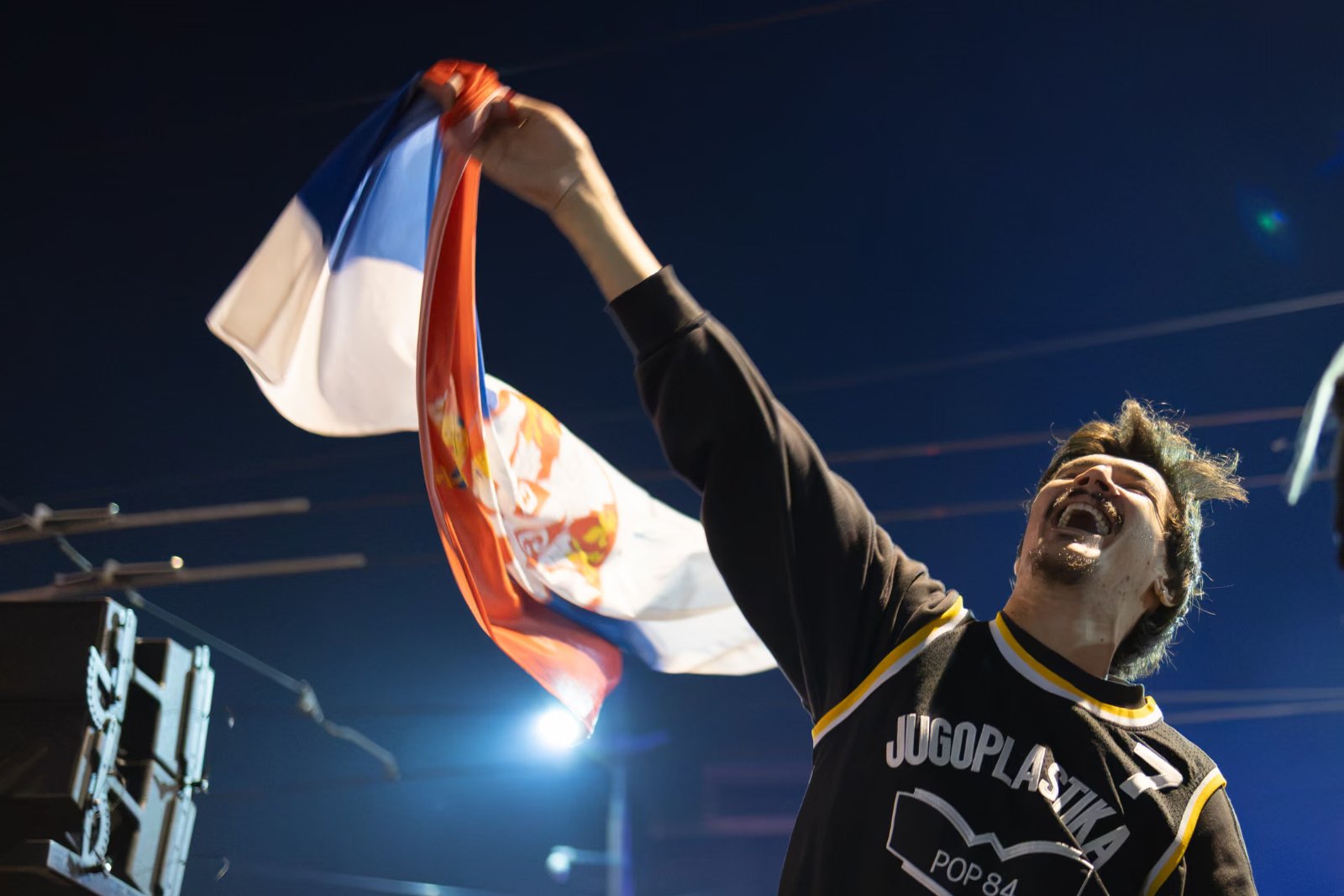
“Expect the unexpected” is the shortest way to describe the outcome of the recent Serbian parliamentary election. More extensively: a group of young, almost unknown outsiders – with no single leader, no formal party structure, and no financial backing – has ousted one of Europe’s most entrenched autocrats. A ruler who controlled national media, police, public finances, and criminal networks, and who relied on a party machine claiming some 700,000 members – roughly one for every nine voters.
Most importantly, Serbian students did all this without a single act of violence throughout their two-year-long struggle. Not bad for a country whose reputation in Western societies has so often been associated with wars and political violence.
Serbia has simply delivered one of the greatest displays of democracy in recent history. For the country, this is a new beginning, a new chapter to be written. And in systemic reform, securing a strong initial foothold is half the battle.
At a time when many European governments face mass demonstrations, protests and even civil unrest, the Serbian peaceful revolution offers the rest of the continent at least three crucial lessons.
1. Empower the young, not the political parties
Serbian students have not only defeated former president Aleksandar Vučić and his longstanding ally, the Socialist Party of Serbia (SPS) – which for the first time will not sit in the national assembly – but they have also bypassed the traditional opposition. Apart from the Student List and the coalition supporting Vučić, no other party passed the 3% threshold, with only SPS gaining over 2%. The students’ victory demonstrates a definitive decoupling between traditional political parties and the real needs of citizens.
One of the key strengths of the student-led protest was the absence of seasoned political leaders. Unlike previous mobilizations – such as the “Serbia Against Violence” movement triggered by the May 2023 mass shootings – the protests sparked by the late-2024 Novi Sad railway station canopy collapse were never hijacked by politicians seeking to revive their careers. Although many opposition parties supported the students’ demands, no leader even tried to co-opt the movement.
This was the result of a deliberate strategy. First, the students insisted on keeping the movement purely civic in its nature and demands. Their primary request was the immediate release of all documents concerning the renovation of the Novi Sad railway station – a direct move to hold authorities accountable for corruption and negligence. They deliberately avoided demanding the government’s immediate resignation, knowing that doing so would politicize the movement and trigger a direct confrontation with Vučić on his own terms. Indeed, when then-Prime Minister Miloš Vučević resigned in January 2025, the mass protests did not stop.
Second, excluding opposition leaders was meant to protect the movement from state propaganda. In a media landscape dominated by the ruling party, placing a figure like Dragan Đilas at the forefront would have allowed the regime’s smear machinery to discredit the entire cause. Attacking students directly proved far more difficult for Vučić’s regime, and it ultimately backfired.
Most importantly, the students sought to distance themselves from traditional leader-centred politics. As their program states, they “did not want a new leader around whom another cult of personality will be constructed.” Rather than fighting for individual glory, they organized horizontally through university plenums, bottom-up democracy labs where decisions were made collectively. They crafted a shared vision for their country’s future rather than projecting it onto a single figure. While this might sound like naïve idealism, in a country where 50% of people aged 15 to 30 plan to emigrate, it reflects a generational necessity.
2. From the periphery to the centre
One of the turning points that made the students’ victory credible was the massive rally held in Slavija Square, in downtown Belgrade, three days before the election. That gathering was a synthesis of their two-year struggle. Slavija represented the final destination of a journey that began in disparate towns and villages across Serbia, converging on the capital in three major columns from the north, east, and west. This method embodied the central metaphor of the movement: bringing demands directly from the periphery to the centre of power.
One of the limits of all previous protests against Vučić’s regime was Belgrade’s borders. The difficulty of extending dissent beyond krug dvojke – as Belgrade’s inner core is known, a term with an elitist connotation – was also evident in the 2023 elections, when the opposition coalition “Serbia Against Violence” gained 24%, marking the best result of any of Vučić’s opponents. But that result was concentrated mainly in the Serbian capital.
The October 25 triumph is, instead, the victory of a truly national strategy. The students avoided Belgrade-centrism both in their list of candidates, since the 250 names were drawn from across the country, and in the program, which envisages better living conditions in rural areas, too.
While in previous mobilizations opposition parties used to hold rallies mainly in Belgrade, barely reaching inhabitants of other regions, the students inverted this model. Leveraging their plenum network, they launched the “Student u svakom selu” (A Student in Every Village) initiative – “not to deliver speeches, but to engage in dialogue, to listen, and to share what lies behind the headlines,” as the Student List program reads. This initiative enabled the students to reach “more than 400 locations, to visit over 40,000 households, and to speak with more than 20,000 people.”
Given that the regime maintained control in the periphery by shutting down local, non-aligned media and denying independent TV channels national broadcasting licences, thereby preventing rural populations from learning about alternative political figures, the students’ door-to-door strategy was indispensable. The success of this approach is reflected in the 69% turnout, the highest since 1990, and in the fact that students won in all main cities and in many of those smaller municipalities where Vučić’s Serbian Progressive Party (SNS) used to win by landslide margins, such as Aleksandrovac, Vrbas or Pirot, to name just a few.
3. Pioneering and tenacious initiatives
The final factor behind the students’ watershed victory was their sheer perseverance. The movement proved to be inclusive, community-driven, and highly innovative. To sustain momentum over two years, students went beyond standard street marches, introducing original actions which were all accompanied by sixteen-minute silent vigils to honour the victims of the Novi Sad canopy collapse.
Starting with university strikes, their tactics evolved into long-distance marches, strategic roadblocks, a bike ride all the way to Strasbourg, and an 18-day ultramarathon to Brussels to present their demands to MEPs.
Most importantly, protests never resulted in acts of violence by students, although there were several attempts to infiltrate and provoke them by SNS activists and henchmen.
The students’ perseverance in pursuing their goals therefore withstood the regime’s repression, which manifested in multiple forms – most severely through what independent investigators concluded was most likely the use of a sonic weapon against the massive Belgrade demonstration on March 15, 2025; police brutality in August of the same year; and the presence of armed criminals at the informal “Ćacilend” camp – where henchmen loyal to the regime were presented as “students who want to study” to counter the student movement stationed with tents in front of the Serbian Parliament for over a year and a half.
In conclusion, a protest that began by requesting government transparency and accountability quickly expanded into a functional campaign against a ruling apparatus characterized by Vučić’s grip on power and the decay of democratic pillars.
Serbian students achieved a historic feat, helping rebuild their country’s reputation and trust in democracy. The three-finger gesture—originally associated with 1990s nationalism, but partly rehabilitated by the movement as it matched their list number—now seems to have acquired a civic and patriotic meaning of liberation from the Vučić regime, standing as the symbol of vindication for a generation that for too long has been driven to plan its life outside the country.
For days, social media feeds were filled with images of a generation celebrating as it takes back the reins of its own future, offering a beacon of inspiration for young people around the world at a time of widespread discontent and mobilization.
Photo credits: https://protesti.pics/