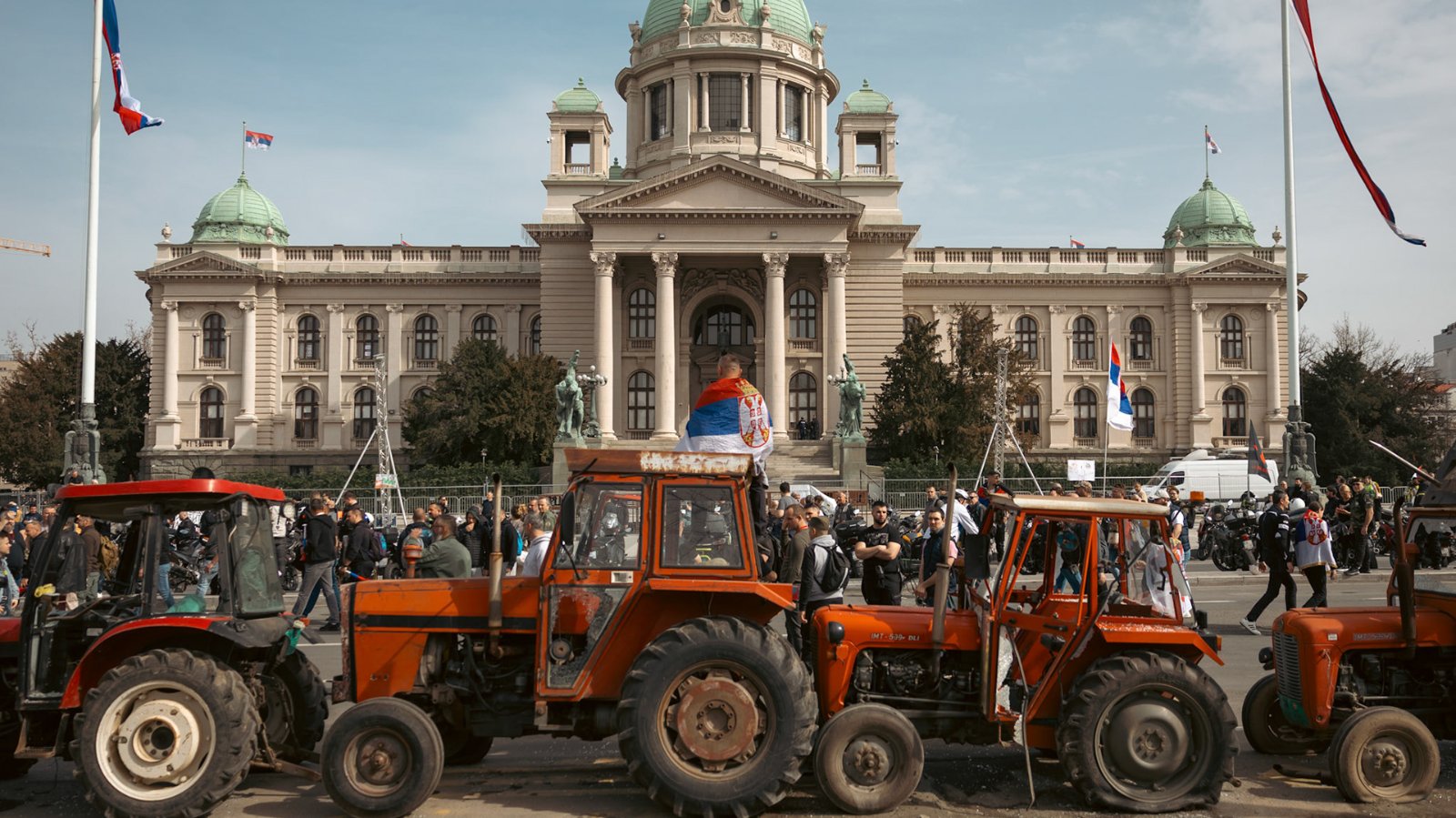
The last days of June in Serbia brought sweltering heat to the political atmosphere as well. This year's Vidovdan – St. Vitus Day, which traditionally commemorates the Battle of Kosovo, Serbia's founding national myth – was celebrated twice, in two parallel Serbian worlds. One was President Vučić's, marked by yet another failed attempt to organise a pompous rally. The other belonged to the student movement, which never misses a chance to reclaim patriotic symbols, thereby undermining Vučić's strategy of casting himself as the ultimate protector of national interests. But this latest student-organised rally raised many eyebrows, as the speeches delivered patriotic pride laced with nationalistic overtones, heavily focused on Kosovo – one speaker even demanded "reciprocal measures" against Albanians in Serbia. Embracing patriotic and myth-making tropes always carries the risk of being overpowered by them, yet the student movement still seems confident in its catch-all strategy, convinced it can manage its many ambiguities and heavy burdens.
More sceptical voices came from parts of the opposition, who used the nationalist excesses of the event to sharpen an idea already in circulation: that we should not rely solely on a catch-all student list for the decisive elections (still unscheduled, but surely ahead of us – at the latest in 2027). They argue that we need a group of decidedly pro-EU opposition parties to compete alongside the student list, since Serbia cannot afford to fall for nationalist fantasies once again and slip off the accession track – especially now that the region is gaining momentum with Montenegro's advance.
But the majority of progressive voices, I would argue, fall somewhere in between: convinced that Serbia's future must be EU-oriented, yet committed to voting for none other than the Student List (SL), as the student movement has proven to be the only political force capable of meaningfully challenging the current regime. Still, they rightly worry about whether SL will be unambiguously pro-EU, let alone prioritise the accession process.
So far, the student movement has exhibited a range of stances towards the EU – from organised cycling trips to Brussels and Strasbourg to overt Euroscepticism – but its official line seems to be one of embracing ideological heterogeneity and adopting a position of "neutrality." This means SL will neither support nor oppose further accession talks, but will instead prioritise internal political "healing," so that once a trustworthy institutional framework is restored, this conversation can continue.
The problem, of course, is that the proposed pause is not only naïve and unsustainable – the so-called neutrality inevitably produces political effects of its own, making it not neutral at all. This is especially true given the numerous geopolitical interests already invested in Serbia, which will not "go on pause" regardless of any political actor's stance. Still, such a position on the part of the student movement is understandable. Citizens' trust in the EU has been eroding systematically – partly due to media capture, which disables any meaningful conversation about the accession process, but more importantly, due to inconsistent messaging from the EU itself, which has failed to unequivocally condemn authoritarian tendencies and has even supported the ruling regime in the face of evident suppression of citizens' and media freedoms.
Recent news of the so-called "Vučić's German" – an official of the German Agency for International Cooperation (GIZ) employed as a consultant to Serbia's president – laid bare how German interests operate in Serbia, further cementing the already prevailing view that the EU means Serbia no good. The trouble is that the media and public sphere are so severely damaged and polarised that it is impossible to hold meaningful conversations about the need to differentiate the EU from individual European countries and their interests. Nor is there room to argue that such direct and blatant influence – exercised not only by Germany but very likely by many other countries, most notably Russia – would have been far harder to exert had Serbia been an EU member. Yet these conversations about sovereignty and the rule of law cannot produce meaningful outcomes in the absence of a healthy public sphere.
So, are the students right, then? Should these conversations be postponed until after a new government is formed? I strongly believe the answer is no, since adopting a temporary "neutral" stance on the EU, given the current geopolitical circumstances, amounts in itself to taking a position. But it would be highly unfair – and politically wrong – to expect only the student movement to refine its approach and rethink its strategy.
If we are to hope that Serbia not only remains on the accession path but also keeps the EU on its horizon, it is even more important for the EU to recognise that continuing any negotiation process with the current regime is a grave and shortsighted mistake. The European Commission's recent welcoming of the alleged improvement of judicial laws – laws actually designed to place the prosecution further under executive control – is just another slap in the face to all those arguing that democratisation in Serbia must be secured through, not despite, the EU accession process.
When we point out to EU officials that negotiating with this regime cannot deliver the European future we hope for, many of us have heard the same bureaucratic mantra in response: "We are not negotiating with governments; we negotiate with states." But pretending not to see how this state has been captured and privatised by the ruling clique risks losing that state as a partner for future engagement altogether – posing no small geopolitical risk to Europe, and, more importantly for us as citizens hoping for a better future, threatening the loss of our society to competing geopolitical projects and value frameworks.
Photo credit: https://protesti.pics/