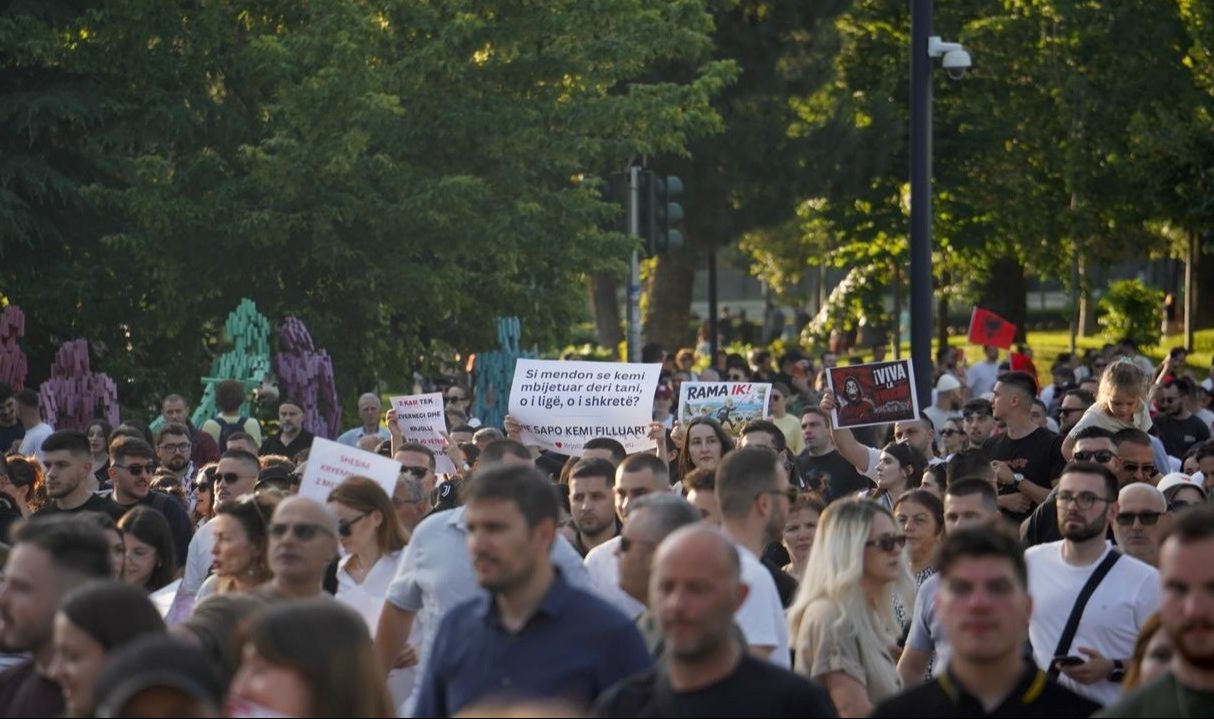
We, the undersigned members of the Balkans in Europe Policy Advisory Group (BiEPAG), express our support for the citizens and students of Albania who are calling for accountability, environmental protection, decent conditions in higher education and a future for young people in their own country.
For months, the Flamingo movement has brought citizens onto the streets in peaceful protest against corruption and the way decisions about the country’s future are made. Since mid-October, students have joined in large numbers, raising concerns about the cost of education, the state of universities and the lack of prospects for their generation. These demands merit serious consideration and are closely aligned with the Union’s core democratic values and the requirements of Albania’s EU accession.
We condemn the violence that has accompanied the recent protests, as well as the disproportionate response by law enforcement. At the same time, violence on the margins must not become a reason to dismiss the legitimate grievances of a generation. The authorities’ response must remain proportionate, and allegations of excessive force against protesters, journalists and minors taking part in protests must be independently investigated. We are also concerned that the measures recently announced by the government in response to the unrest point towards retribution rather than justice.
We agree with the European Commission that, in a candidate country, grievances should be addressed through constructive dialogue.
The EU has already demonstrated the value of engaging directly with Albanian citizens. Visits by Members of the European Parliament to Tirana this summer helped bring protesters’ concerns into the European debate, while Commissioner Kos subsequently emphasised that environmental protection and the democratic handling of protests are integral to Albania’s accession commitments. This engagement created an important opportunity to strengthen the connection between citizens’ democratic demands and the EU accession process. That opportunity should not now be squandered. EU integration must not be merely a process negotiated between governments; it must also be one in which citizens’ voices are heard and their demands for democratic accountability are taken seriously.
The government’s refusal over recent months to address these demands meaningfully, together with confirmed incidents of excessive police violence, has made credible dialogue more challenging. A genuine process requires a facilitator whom both sides can trust. The EU is the only credible actor capable of playing that role and has a positive track record of doing so.
The EU enjoys overwhelming support among Albanian citizens, and protesters look to its values. The EU accession project remains the only viable political project broadly embraced by a majority of Albanian citizens. With Albania now a frontrunner in the accession process, the EU’s leverage in the country is greater than ever. It therefore has both the opportunity and the responsibility to facilitate a way out of the deep political crisis before it escalates further. This is an opportunity for the European Union to demonstrate greater engagement and ensure that reforms are irreversible and have a meaningful impact on citizens’ futures.
Recent examples of the EU’s rapid responses to political crises in the region have demonstrated how important such engagement can be in advancing a country’s EU accession process. They have also shown that the EU possesses both the authority and the capacity to act as a constructive facilitator during periods of severe political stalemate. We believe that such engagement is equally vital in Albania today.
We therefore urge the European Commission, the Council of the EU and the European Parliament to use the tools at their disposal to facilitate a structured dialogue between the government and representatives of students, protesters and civil society. The EU should make clear that progress on the accession path depends first and foremost on respect for EU values and norms. The credibility of enlargement rests on the EU standing with citizens who demand the very democratic standards it asks candidate countries to uphold.
The Balkans in Europe Policy Advisory Group BiEPAG
Photo credits: by Davin Çeço, freelance photographer.Taken during the June rallies in Tirana, 2026.