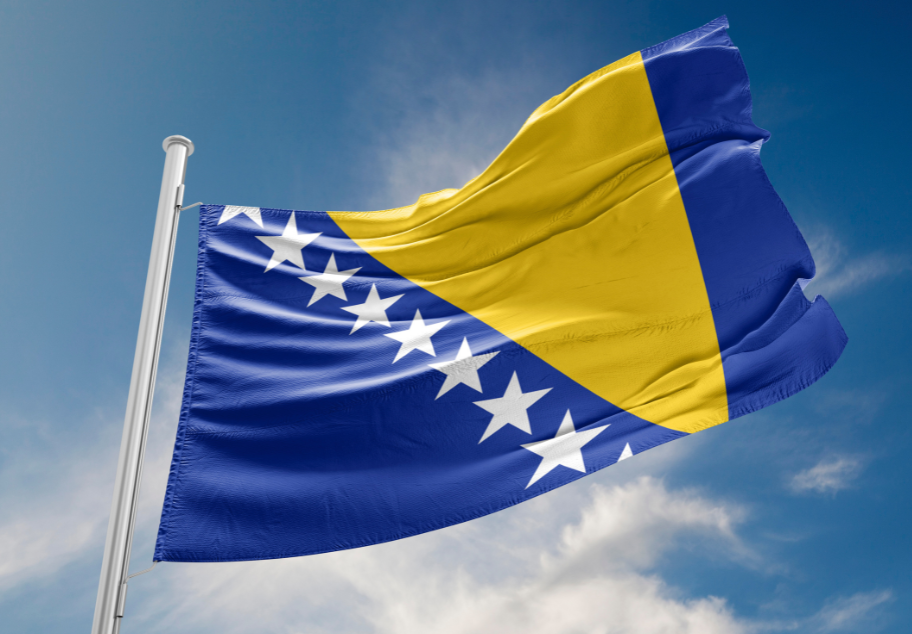
Three months ago, when midfielder Ermin Mahmić scored the third goal against Qatar, the Bosnian national football team knew they were about to do something big. For the first time, Bosnia and Herzegovina made it beyond the World Cup group stage. The tournament introduced a wider audience to this country from the Balkans, its recent past and how diaspora-born players contributed to the achievement of such an unprecedented sporting success. The parade of fans marching toward the stadium, the mass chanting of Halid Bešlić’s unofficial Bosnian anthem, and their solidarity with Palestinians helped win them worldwide sympathy.
However, the Bosnian dream was interrupted at the round of 32, when they lost to the host nation, the United States.
Bosnian citizens quickly returned to the problems of old, namely a state fractured along ethnic divisions, dysfunctional institutions and the general lack of opportunities, especially among young people, whose main prospect is emigration. What was not expected in those same days was that the international community was about to forget Bosnia and Herzegovina.
July 14 marked the deadline for reaching consensus about the next High Representative, who heads the Office of the High Representative (OHR), an impartial institution established after the war to safeguard Dayton Peace Agreement provisions. The real news was that the failure to appoint Christian Schmidt’s successor was no longer news at all. The divisions within the Steering Board of the Peace Implementation Council were confirmed once again, while the temporary mandate of Schmidt’s deputy, Louis J. Crishock, expired to little notice.
The failure to make this diplomatic appointment says more about those making the decision than about Bosnia itself, a country traditionally seen as incapable of reaching consensus.
Trump’s administration has been pushing the candidacy of Italian diplomat Antonio Zanardi Landi, who was also backed by Italy, while France and other European states opposed it. While Zanardi Landi is regarded as too close to Washington, the opposition to his appointment appears to have been driven more by the desire to block a diplomat seen as too loyal to Trump’s US than by a commitment to safeguarding the Dayton provisions, after a year in which the OHR had been repeatedly attacked by Bosnian Serb secessionists. Today, just a few days before the general elections, the post of High Representative remains vacant, and this does not seem to pose a problem for the international community.
So, what does the failure to appoint a new High Representative reveal? Far from being a mere procedural deadlock, it exposes deeper fractures among those responsible for Bosnia’s post-war order. Ironically, the international community appeared weak and internally divided while addressing stability in the weakest and most divided country in Europe.
The current US administration appears increasingly concerned with pursuing its own strategic interests rather than with preserving the post-Dayton system. Washington’s approach suggests that the United States today seeks to engage with Bosnia as if it had fully functioning institutions, rather than as a state still stuck in an endless post-war period – as if it were not the country for which, over thirty years ago, it worked tirelessly to broker a peace agreement that, despite its flaws, remains the most significant US diplomatic achievement in the region.
This shift is reflected in the administration’s “Report to Congress on United States Policy to Promote Regional Stability and Prosperity in the Western Balkans,” which states that “the nation-building era has passed.” Such a position would be understandable if Bosnia had developed resilient institutions capable of managing recurring political crises. Instead, the country's constitutional order remains contested, its territorial integrity continues to be challenged, and Russia still exploits its internal divisions. The same logic has also informed Washington’s decision last year to lift sanctions on Milorad Dodik and host him in the United States, a move that, on the eve of the general elections, could be widely interpreted as conferring renewed political legitimacy on Bosnia’s main secessionist leader and his allies.
Besides illustrating the current fragility of transatlantic relations, the inability to reach consensus on the next High Representative also confirms the lack of political cohesion among European states. At a time when Europe needs greater political unity, enhanced strategic autonomy and, consequently, to reinvigorate the enlargement process by enriching it with a geopolitical dimension, European capitals appear incapable of agreeing on an appointment that, at least on paper, helps to safeguard stability in an EU candidate country in the Union’s neighbourhood. This disunity stems not from differing views on Bosnia’s future, or on whether and how international supervision of the country should continue, but from an inability to agree on a common geopolitical course. The main consequence of this misalignment is that it exposes Europe’s inconsistency. On the one hand, European capitals have been committed to assuming more responsibility for the continent’s security; on the other hand, they apparently have not yet acknowledged that such a lack of political cohesion benefits primarily Russia, which has its main political ally in Europe in the form of Bosnian Serb secessionists.
Finally, the failure to agree on the next High Representative leads to a very simple question: is the OHR still needed? The High Representative – a post that exists only in Bosnia and Herzegovina – has always embodied the paradox of institutional self-transcendence: its ultimate success lies in making the OHR unnecessary. At the beginning of his mandate, Christian Schmidt set himself the goal of becoming the last High Representative. It is still unclear whether he succeeded; what is clear is that he helped erode the institution itself. Schmidt will likely be remembered in Sarajevo less for his popularity than for reviving the Bonn powers after years of limited application. Ironically, the Bonn powers may be the only issue on which Bosnia’s international partners still agree: that they should be used as little as possible. In fact, the Bonn powers and the OHR itself have been seen by many Bosnian citizens as neocolonial instruments with no democratic legitimacy that leave Bosnia a country still incapable of addressing its own crises without external intervention.
In conclusion, the debate should shift towards how the international community can contribute to further stabilising Bosnia and Herzegovina rather than remain focused on a procedural appointment that risks turning the OHR itself into an obsolete institution able only to preserve the illusion of safeguarding peace in the country.