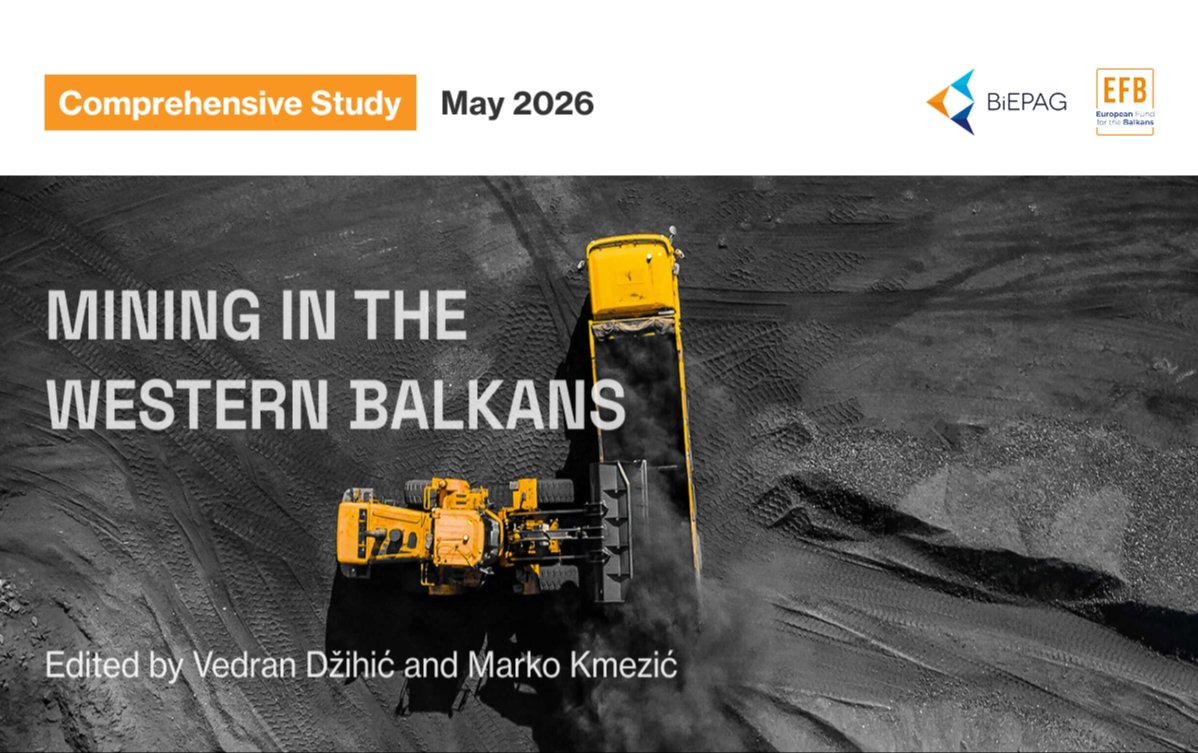
The European Union’s renewed focus on enlargement is unfolding alongside a major transformation in its industrial and strategic priorities. As the green and digital transitions accelerate, access to critical raw materials such as lithium, cobalt, nickel, rare earth elements, and other strategic minerals has become central to Europe’s competitiveness, security, and geopolitical autonomy.
This shift places the Western Balkans in a particularly sensitive position. The region possesses significant mineral potential and is increasingly viewed as a near-shore source of critical raw materials for the European Union. At the same time, mining projects are emerging in political environments marked by weak institutions, limited transparency, corruption risks, and contested public participation.
The BiEPAG study examines how the European Union’s Critical Raw Materials Act, strategic partnerships, bilateral memoranda, and enlargement conditionality intersect with mining governance across the Western Balkans. It asks whether the EU’s growing demand for resources can be reconciled with its commitments to democracy, rule of law, environmental protection, and accountable governance.
The study also looks at local dynamics surrounding existing and planned mining projects, including their political, economic, social, geopolitical, and environmental implications. Cases such as Serbia’s Jadar lithium project illustrate how mining has become a flashpoint for wider concerns about state capture, environmental degradation, public trust, and the credibility of EU enlargement.
By connecting EU-level policy debates with developments on the ground, the study explores whether resource-driven geopolitics risks undermining the EU’s normative role, or whether it can be integrated into a credible enlargement strategy that strengthens both European resilience and democratic governance in the region.
This study is the final product of the projectEU Interest in Mining Projects across the Western Balkans, conducted by the Balkans in Europe Policy Advisory Group (BiEPAG). The project was funded by Stiftung Mercator, but does not necessarily reflect its views.