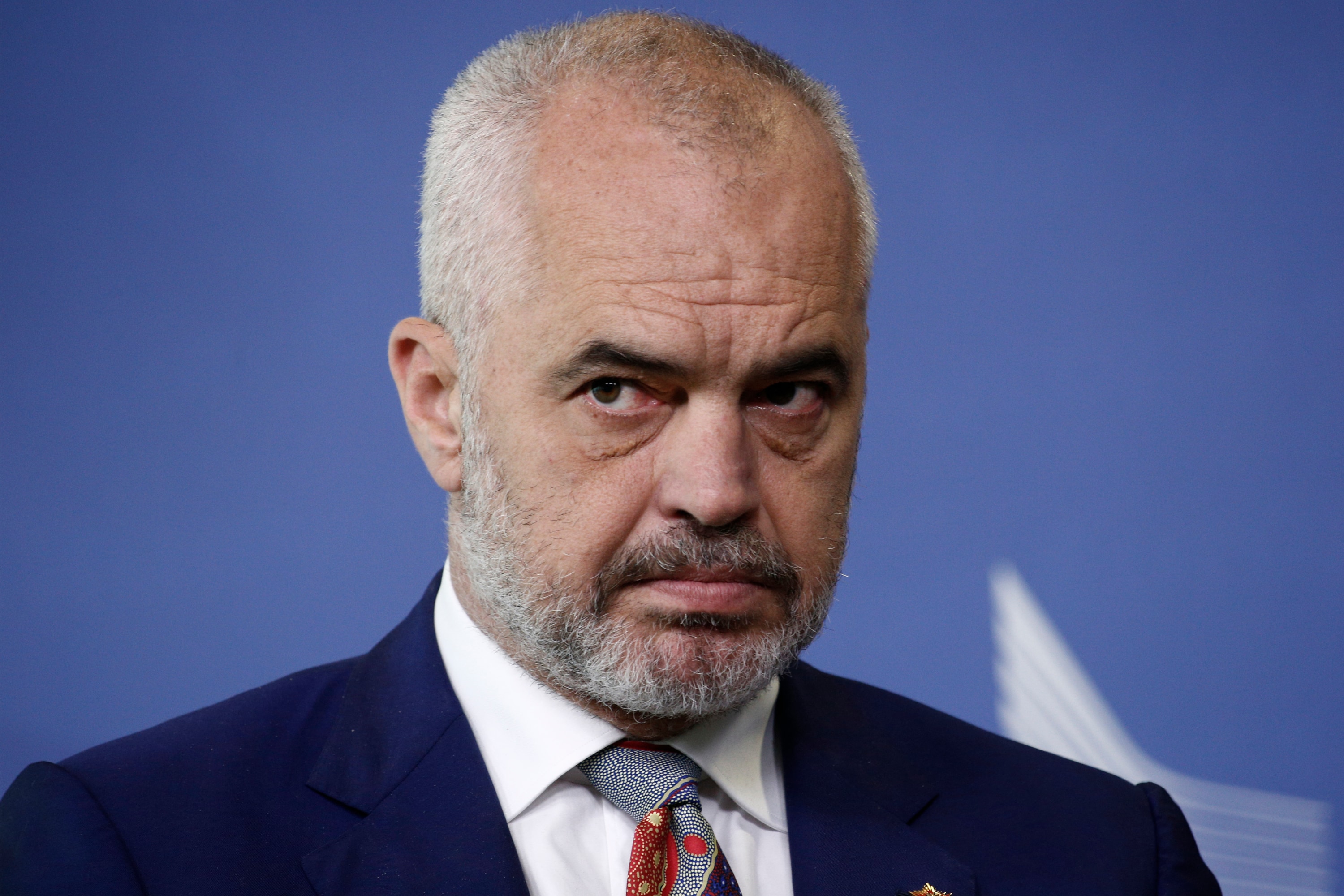
Despite a rather inconvenient pile of evidence linking members of the Socialist Party of Albania (SP) and Edi Rama’s government to corruption allegations, Rama still “rejects with disdain” the assumption that he leads a corrupt party and government and that the country might be firmly in the grip of systemic, exploitative corruption. During a local party assembly in Tirana, he appeared offended by the allegations, arguing that Albania’s ongoing economic growth disproves them. In his view, if corruption were more widespread, the economy would not be expanding as it has.
Not only is this incorrect, but it amounts to a deliberate political distortion of basic economic reasoning that Rama deploys to deflect attention from the issue of corruption, especially as he continues to reshuffle his cabinet since 2013, when he initially took office, in response to Socialist ministers being arrested or indicted on corruption charges and other offenses. The most recent case concerns Belinda Balluku, former Deputy Prime Minister and Minister of Infrastructure and Energy, who has been accused by the Special Structure Against Corruption and Organized Crime (SPAK) of irregularities in the allocation of public procurement contracts during her time as minister. Balluku’s ongoing investigation has triggered yet another cabinet reconfiguration and further strained executive–judicial relations, as Rama publicly extended political backing to her while also attacking (SPAK).
The issue is not simply the number of high-profile cases involving the current ruling administration, but the recurring pattern they reveal: when allegations consistently emerge within the same governing structure, they point to systemic vulnerabilities rather than isolated incidents. Yet Rama continues to frame them as exceptions while exploiting macroeconomic indicators to obscure the elephant in the room.
The “economic growth” he invokes is primarily measured by Gross Domestic Product (GDP), which reflects the total value of goods and services produced within an economy and is usually calculated from components such as consumption, investment, government spending, and net exports. While GDP captures the scale of economic output, it reveals little about how wealth is distributed, who ultimately benefits, whether outcomes are distorted by corruption, or, most importantly, whether such growth is sustainable or socially meaningful.
According to data from the Institute of Statistics (INSTAT), Albania recorded an average GDP growth of 3.8%, with annual growth of 3.79% in 2025. This expansion has been driven largely by construction (7.36%) and real estate activities (6.25%), as well as significant public-sector spending (8.30%). In national accounting terms, government-financed infrastructure projects and the awarding of construction contracts raise GDP through increased gross fixed capital formation, higher aggregate demand, and short-term employment effects. However, this pattern of growth appears to be disproportionately driven by public-sector intervention rather than private-sector productivity and market-based expansion, raising concerns about its sustainability and efficiency.
When growth relies heavily on government spending and contract allocation, it may reflect weak private-sector dynamism and the risk of resource misallocation, conditions that can be associated with governance mismanagement, including corruption. In such contexts, it can be interpreted that corruption can even temporarily inflate measured growth, for instance through public–private partnerships (PPPs) or overvalued public procurement.
Although GDP growth, or its manipulation for political gain, does not measure corruption, nor can it, by itself, demonstrate its decline, a closer breakdown of the data can still reveal patterns that raise legitimate questions about it. Therefore, not only is Rama’s claim that so-called “economic growth” signals a decline in corruption incorrect, but it also works against him.
This type of growth structure is potentially problematic, particularly given the heavy concentration in construction and real estate, sectors that in Albania are often associated with heightened exposure to corruption and money laundering risks. According to the World Bank Enterprise Surveys (WBES), a significant share of construction businesses in Albania, report direct exposure to bribery, both in incidence and frequency, indicating that corruption is embedded in business–state interactions, something that GDP growth figures alone cannot capture. About 28% of businesses report being asked or expected to pay bribes for construction permits, four times the regional average of 7%, and this share has tripled since 2019. Nonetheless, Rama has dismissed as “disgusting” and “unacceptable” any link between Albania’s construction sector and corruption.
Moreover, external inflows, such as remittances (on which Albania is highly dependent) and foreign direct investment, which according to World Bank data amounts to around 6% of GDP in Albania in 2024, play a significant role in sustaining investment and aggregate demand. While relatively high, such inflows indicate reliance on foreign capital rather than necessarily reflecting domestic productivity gains. At the same time, inflationary pressures can artificially increase nominal GDP. Rama claims that salaries have increased, but inflation has also risen moderately too. Wage increases refer to nominal income gains and do not necessarily translate into higher purchasing power, especially when prices are rising. Taken together, these factors can boost growth figures without necessarily signaling underlying structural improvements.
More importantly, the relevant benchmarks for assessing corruption lie elsewhere: transparency, the rule of law, independent democratic institutions, a free media, and meaningful political accountability. The evaluation should be made along these dimensions. By shifting the debate toward aggregate growth figures, Rama avoids engaging with the institutional indicators that would more directly expose governance failures and entrenched corruption risks.
Both the EU Progress and Rule of Law Reports consistently identify corruption as systemic and among the most persistent concerns in Albania, including for its path toward European integration. Transparency International ranks Albania at 39/100 on its Corruption Perceptions Index, with a three-point decline from 2024 to 2025, indicating persistently high levels of perceived corruption, weak rule of law, risks of state capture, and limited accountability. This data does not point to a few bad apples but to a captured system where the ‘strongest’ dictate the rules.
Edi Rama cannot be offended by corruption, because corruption is his guarantee of staying in power.