The Serbian students, currently representing the strongest opposition movement to strongman Aleksandar Vučić, recently published their “Memorandum on Kosovo and Metohija” which sparked significant controversy both in Serbia and abroad.
Many found it problematic that the Student movement, essentially a catch-all movement focused on democracy and the fight against corruption, even adopted a document on Kosovo, an issue which historically empowered nationalist forces. Others were downright appalled by its rhetoric and substance.
The text is steeped in nationalist epic imagery, referring to “sacred values” and “blood-soaked fields”, claiming that “preservation of Kosovo and Metohija is the common denominator of all our endeavours” and that the Memorandum is a “reminder that our struggle for Kosovo and Metohija is simultaneously a struggle for our honour, our culture, and our future”.
However, the Memorandum says very little about how the issue should be resolved. It states that Kosovo is an integral part of Serbia, that the resolution should be based on its Constitution and sought within “complex currents of the international community”. The stated goal is a “model that, through consistent respect for international law, will ensure peace, security, and full protection of rights for the people living in this territory.”
Essentially, the position laid out in the document does not differ significantly from the position of other political parties in Serbia and represents a clear political mainstream. The true controversy of the Memorandum does not lie in any proposed actions, but in its language and the apparent acceptance of nationalist rhetoric.
However, while in Serbia critics mostly see the Memorandum as a disappointment which is unlikely to change voting preferences, many international observers perceive it as evidence that the Student movement is nationalist and not a welcome alternative to Vučić.
This is not the first time that the issue of nationalism among Serbian students generated divisions and drew significant attention internationally, especially as nationalist elements and statements became more notable.
But while these concerns are legitimate, the stark difference between how things are seen by Serbian progressives and outside observers demonstrates far bigger problems – the existence of a parallel reality in Serbia and the lack of understanding abroad of how this “Serbian reality” affects the possibility of democratic changes.
The Student movement in Serbia emerged after the Novi Sad railway station tragedy on 1 November 2024 and was the main driver of mass protests. The movement represents a complex and decentralized structure which emerged during the student blockades of their universities in late 2024.
For months the student protests demanded accountability, the rule of law and the fight against corruption, insisting that the “institutions should do their job” rather than calling for government change.
It was only in the Spring of 2025 that the students demanded elections and committed to fielding a “Student list”, an electoral list to be chosen by the students, but composed exclusively of non-students. This essentially transformed the protests into a political competition, with both the Student movement and the ruling coalition being in a permanent electoral campaign.
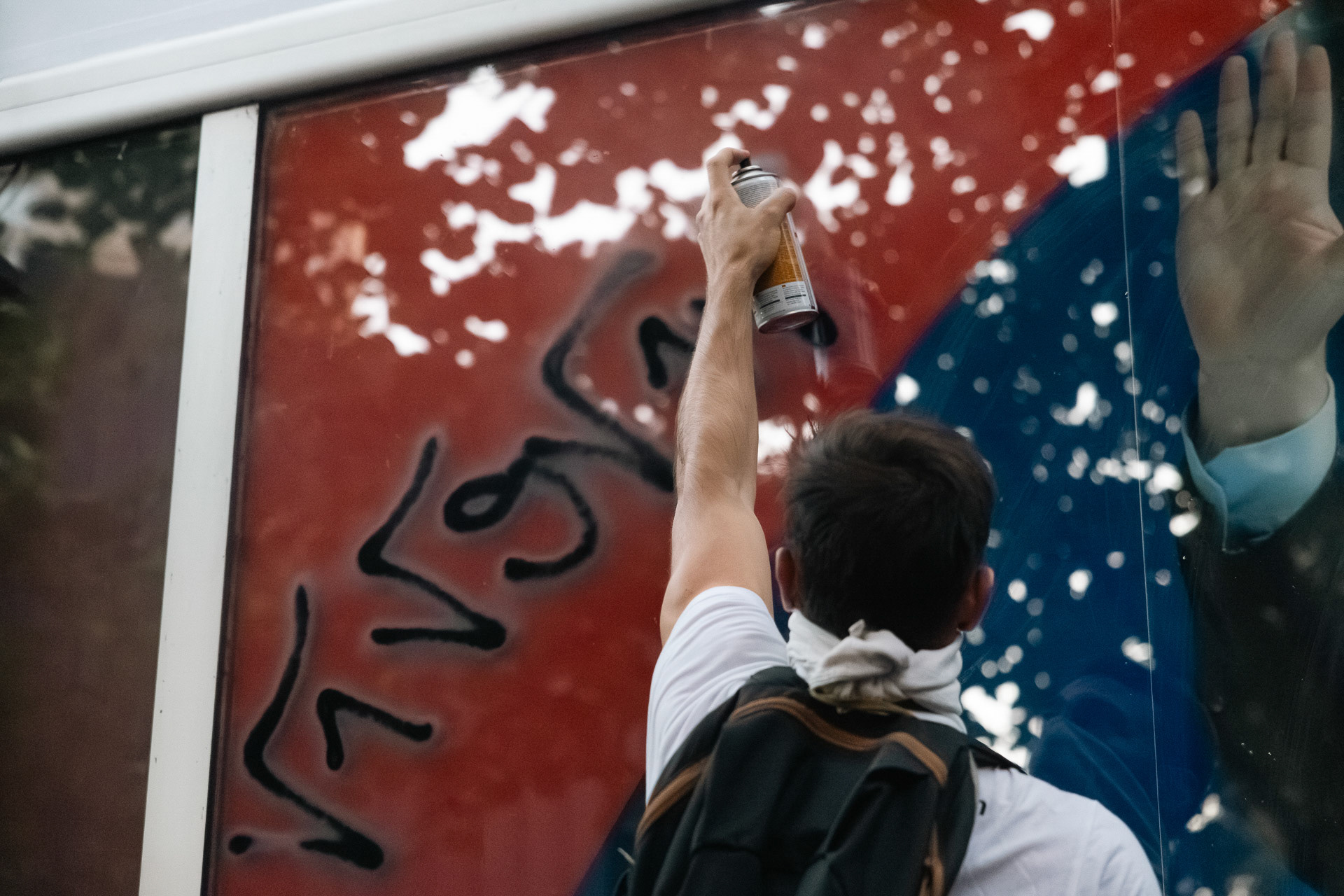
The regime has built their entire anti-student campaign around nationalism, accusing students of trying to destroy Serbia with the help of “Serbia’s enemies”. A particularly ugly part of this campaign was the mass vandalization of Belgrade and other cities with thousands of graffiti accusing the students of being terrorists, “ustaše” and “Šiptari”.
For the Student list to win, it needs to take away votes from the ruling coalition and thus needs to be acceptable to nationalist “soft supporters” of the government. This is why the government is using nationalist attacks against the students and probably why the Student movement feels that it needs to respond.
The students were previously very successful in using an inclusive and constitutional form of patriotism to mobilize support and achieved a historic rapprochement between ethnic Serbs and Bosniaks in Serbia.
Ideologically heterogeneous and often contradictory, the Student movement has often balanced between occasional nationalist outbursts and clear pro-EU actions, such as cycling trips and relay races to Strasbourg and Brussels, visits to EU capitals and meetings with high-level EU officials.
However, the use of more nationalist rhetoric can easily backfire and create divisions among their supporters, insert new divisive topics that would blur the main political divide, and tarnish the Student movement’s own international reputation.
The students’ position in the Memorandum hardly comes as a surprise. The rhetoric did shock many, but the main points could easily be predicted, as they do not differ significantly from those of other political parties.
By referring to the Serbian Constitution and committing to the defence of Kosovo and Metohija as a part of Serbia, the Student movement actually took a safe position. While it might be seen as controversial by some international observers, in Serbia this is a mainstream position.
Kosovo is a highly symbolic issue in Serbia, with very little public debate about Serbia’s position, interests and realistic options for its resolution. The entire society “buried its head in the sand” for years, ignoring the realities of the normalization process.
Through its propagandistic media machinery, the Serbian government controls the discourse about Kosovo and there is little space for the opposition to offer new ideas without being labelled as traitorous. Simply put, Kosovo is an issue on which no political actor can gain votes, but can easily lose them.
With this in mind, it would be unrealistic to expect that the heterogeneous Student movement – up against a government-run media machinery and aiming to win over nationalist votes – would express unpopular opinions on the most sensitive topic in Serbian politics, especially since the Kosovo issue is not central to their campaign.
The key question, however, is what is the significance of this? Is it just an electoral strategy or a demonstration of the students’ nationalism? Also, if the latter is the case, what will that mean if the Student list wins and takes part in a future government?
The first question is hard to answer. There is definitely an electoral strategy in winning the nationalist votes and defending against regime propaganda. At the same time, it is highly probable that one part of the movement does hold nationalist positions. There is also a possibility of malicious external influences on student structures to push them in problematic directions.
The second question is easier. A lack of genuine vision in the students’ position is regrettable, but it is unlikely to have significant consequences. The Student list will be ideologically heterogeneous, meaning that divisive issues such as Kosovo, Russia or EU integration are likely to pose serious challenges after democratic transition anyway.
But perhaps the main question, especially for those living in Serbia, is whether this Memorandum or similar nationalist episodes increase or reduce the chance for the defeat of the autocratic government, a conditio sine qua non for Serbia’s democratization, EU integration and stability in the Balkans.
They can certainly be damaging. The more divisive identity issues become a part of the campaign, the more they undermine a referendum-like atmosphere seen as crucial for victory against the current regime. No opposition actor has ever managed to seriously challenge Vučić “from the right” on issues such as Kosovo, and understandably so. That’s his “home turf”.