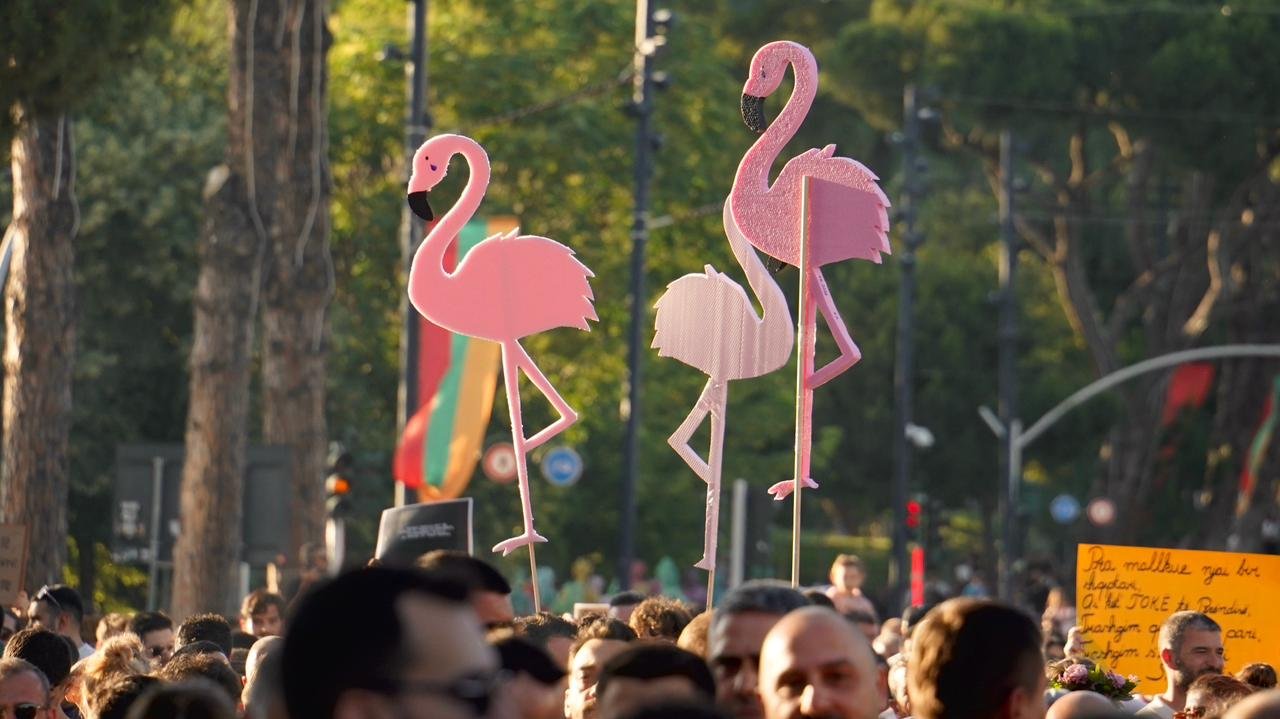
In Tirana, Albania, peaceful but determined protests against the Zvërnec mega-resort project have unfolded over the past week, with citizens demanding transparency and environmental protection. The peaceful marches in Tirana have become a prism through which Albania’s systemic weaknesses are exposed: violence subcontracted to private guards, laws bent by opaque amendments, and a media landscape so captured that disinformation replaces journalism. For an international audience, the protests are not just about flamingos — they are about democracy fenced off and lack of transparency. Despite attempts to shame the protesters as anti‑investment, racist, or financed by foreign interests, the rallies remain peaceful and resolute, with citizens pressing clear demands for transparency and accountability in government decision‑making.
On 23 May, residents and environmental activists protested against the fencing of Pishë-Poro beach in Zvërnec, part of the Vjosa–Narta protected landscape. They accuse oligarchs and politically connected businessmen of illegally seizing land.
On 30 May 2026, protests in Zvërnec escalated when private security guards from the company Major Security assaulted and restrained a demonstrator. State police were present but failed to intervene, prompting disciplinary proceedings against the Vlorë Police Directorate. This has fuelled public anger and reinforced perceptions of institutional complicity.
The Zvërnec South Adriatic Development project seeks to transform one of Albania’s most fragile ecological zones into a luxury resort complex. The Vjosa–Narta region, designated a Protected Landscape in 2004 and further strengthened by the 2017 Law on Protected Areas, is a sanctuary for flamingos, pelicans, migratory birds, and hundreds of protected species.
Yet in 2024, amendments under Law 21/2024 opened the door to tourism-related development. Critics argue that no credible scientific or ecological evidence has been presented to justify these changes. The project threatens wetlands, lagoons, and biodiversity, raising alarm among environmental organisations and citizens across country.
Behind the glossy renderings of villas and five-star resorts lies a murky reality: offshore registrations, anonymous ownership, and contested property rights. The project is not simply a matter of tourism; it has to do with power, secrecy, and the erosion of Albania’s environmental and civic protections.
Mainstream Albanian media have largely ignored live coverage or spread disinformation. ABC News and Top Channel aired AI-generated images claiming Greek sponsorship of the protests, invoking old nationalist rhetorics over the Ionian Sea in an attempt to fade the protests. Other outlets have attempted to delegitimize the movement with accuses of using anti-Semitic rhetoric.
By contrast, other smaller media outlets such as Citizens Channel and social media have documented the reality: peaceful marches in Tirana, families with children, and generally middle-class demanding transparency. Reporter.Al has also conducted a thorough investigation into the matter. This grassroots reporting has exposed the disconnect between captured national media and civic truth.
The disinformation campaigns serve a clear purpose: to obscure the deeper story of opaque offshore structures, contested property rights, and oligarchic interests. While most of the rhetoric of pro-government opinions on mainstream media frame the protest as anti-development and anti-foreign investment, the truth remains that the citizens in fact claim transparency and information by Albanian government. International figures like Jared Kushner and Ivanka Trump have been pushed to the fore in media headlines, but investigations show these are distractions. The real drivers are Albanian elites, unresolved legal battles, and government-backed development in one of Europe’s last wild ecosystems. Albania’s SPAK anti-corruption prosecutors are investigating changes in protected status and land ownership made in 2024, which opened the door to tourism development.
Independent investigations conducted by BIRN, Exit.al, and Reporter.Al reveal that the Zvërnec South Adriatic Development project is far from the glossy image of international investment presented in mainstream narratives. The company behind the resort is registered in the Netherlands under an opaque trust structure, with its beneficial owners undisclosed. This lack of transparency has fuelled suspicions about the true nature of the project and its backers.
Behind the façade, an investigation by Reporter.AL claims that the real network involves Albanian businessmen with controversial pasts. Among them is Artur Shehu, a Vlora-born businessman residing in the United States, whose name has been tied investigations in Italy. Another key figure is Pëllumb Petritaj, a lawyer repeatedly accused and convicted of falsifying property documents, whose family has secured large parcels of disputed land in the area. A further figure in the controversy is Alaudin Malaj, a former judge removed from the judiciary during Albania’s vetting process, who issued rulings in favour of Shehu’s claims to contested property.
The investigation also highlights the role of Musa Kastrati, son of oligarch Shefqet Kastrati, one of Albania’s most powerful businessmen. Kastrati Junior has been present at meetings with Ivanka Trump and Prime Minister Edi Rama, allegedly negotiating with landowners. His involvement underscores the influence of entrenched oligarchic networks in advancing the project.
The scale of development is staggering: plans envision up to 10,000 accommodation units, covering more than one million square metres of land, much of it tied up in unresolved property disputes. Contracts involve over 250 hectares of contested property, fenced off from locals who now bitterly remark that they need “a visa to enter their own land.”
The evidence paints a picture of a project built not on transparent investment, but on contested ownership, political patronage, and the erosion of environmental safeguards.
Some commentators attempted to delegitimise protesters by associating them with antisemitic slogans. In reality, the demonstrations have been peaceful, diverse, and inclusive, gathering thousands of citizens, with Millennials and Gen Z forming the majority, united across ideological lines in a common call for transparency. The accusations against them appear less like genuine critique and more like part of a deliberate strategy to stigmatize civic mobilization..
Prime Minister Edi Rama described the Zvërnec incident as “an isolated case” fuelled by “widespread disinformation” and insisted that reputable international investors were being obstructed. This framing shifts attention away from unresolved property disputes and the violent conduct of private security, while delegitimising the protesters as misinformed or manipulated.
The protests are not against tourism developments or foreign investments, as wrongly claimed in an effort to minimise their cause. Protesters are advancing clear messages and chants against secrecy, violence, and disinformation. In fact, the protest now channels multiple discontents felt especially by Millennials, young professionals, families, and Gen Z.
While protests in Tirana remain peaceful and committed, Albanian diaspora have also mobilised digitally, launching an online petition to the Government of Albania, the European Commission, the European Parliament, and international environmental organisations, demanding:
In the past days diaspora has also mobilized and notified coordinated protests in main cities across Europe.
What began as scattered grievances around Zvërnec has now crystallized into a unified demand for the resignation of Prime Minister Rama, alongside concrete calls for: repeal of the 2004 Protected Landscape designation amendments (Decision No. 680), review of Law No. 81/2017 on Protected Areas, annulment of Law No. 21/2024 that opened the door to tourism development, revision of the so‑called ‘Mountain Package’ affecting communal lands, and full transparency in the legislative process.
In recent weeks, Albania’s citizens have shown a quiet but determined unity. Families, students, and professionals have marched side by side, keeping their protests peaceful while insisting on transparency and accountability. Efforts to discredit them through AI‑generated images, nationalist tropes, or unfounded accusations have not succeeded. Instead, the cohesion of these demonstrations has demonstrated that civic resistance in Albania can remain inclusive and resilient, even when challenged by disinformation and attempts to fence it off.
Photo by Davin Çeço, freelance photographer. Takenduring the June rallies in Tirana,2026.