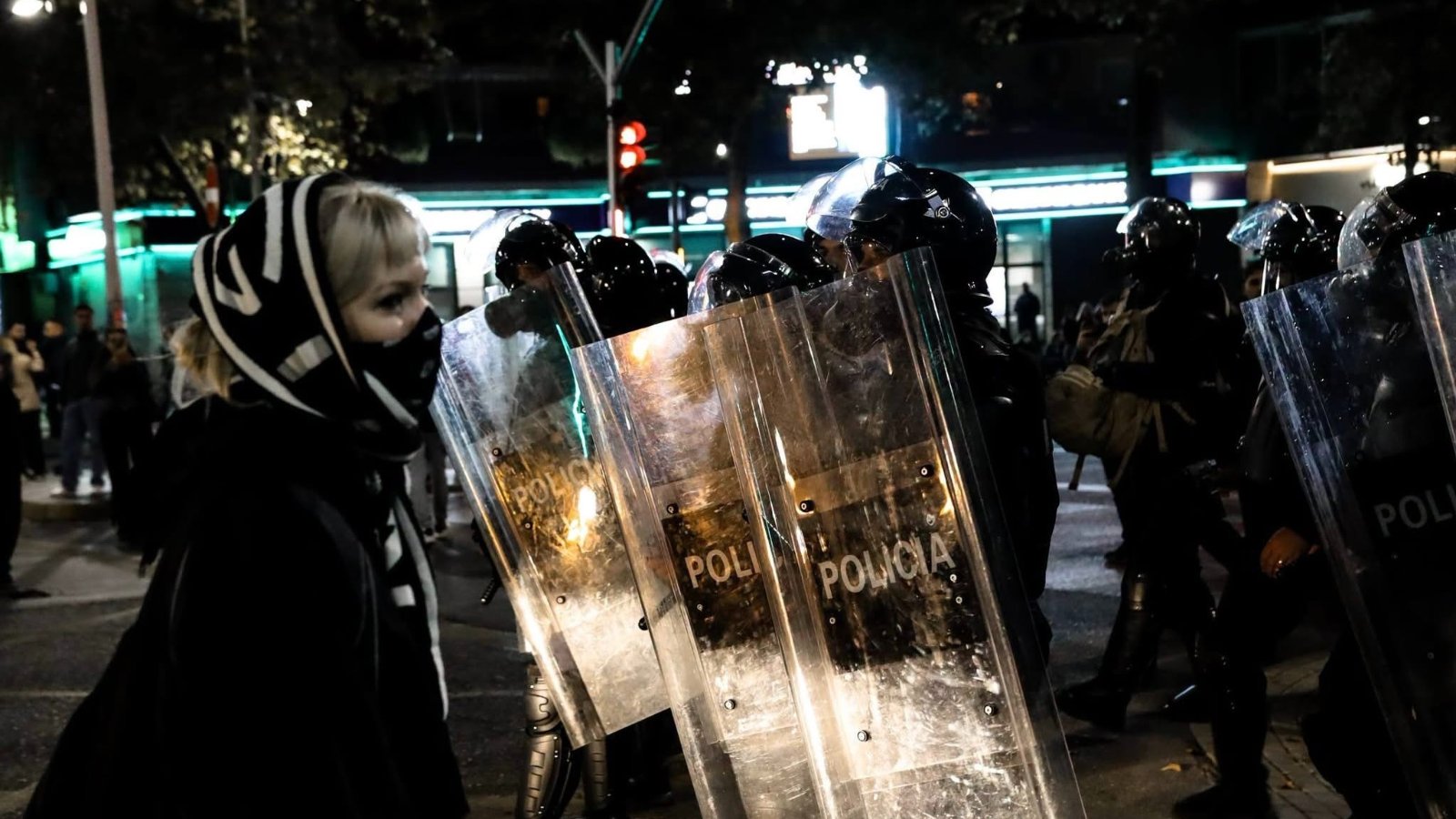
On Wednesday, 14 October, student-led protesters set fire to Albania’s Ministry of Justice. Earlier that day, the Ministry of Education had also been targeted. Other government buildings and state institutions, including police stations, came under attack, as did the headquarters of the ruling Socialist Party and the opposition Democratic Party in Shkodër. The unrest also spread to the private sector, with protesters targeting Albanian-owned banks in Tirana, including Credins Bank and the National Commercial Bank (BKT), as well as businesses linked to domestic oligarchs and companies criticized for operating as pyramid schemes.
Beyond the attacks on institutions and businesses, widespread vandalism has been reported across the streets. Security devices, including AI-powered biometric surveillance cameras in the capital, have been smashed, along with advertising billboards and other public infrastructure. At the same time, protesters are safeguarding small businesses and have explicitly called for them to be left untouched. They have also been seen shielding and assisting street vendors selling books, flowers, and food. The movement has made clear that its targets are the government, the mainstream opposition parties, the police and, above all, the organized crime networks that sustain corrupt politicians and help keep them in power. However, the crowds have also been infiltrated by regime-affiliated provocateurs, alongside individuals linked to the traditional opposition, which has been unsuccessfully attempting to co-opt these movements since June.
The protests initially began on Tuesday, 13 October, at the initiative of university students. Having returned to lecture halls a week earlier for the start of the new academic year, students at the University of Tirana called for a mass boycott of lectures and organized a protest of their own. Their mobilization soon converged with the Flamingo movement, with the two joining forces and bringing together a range of grievances and demands. These included better educational conditions, lower tuition fees and improved employment prospects for graduates, alongside calls to scrap the Kushner–Trump-backed project in the Vjosa–Narta Lagoon, repeal the 2024 Law on Environmentally Protected Areas and the 2015 Strategic Investment Framework, and, above all, demand the resignation of Prime Minister Edi Rama and his entire government.
The first day of protests was marked by violent clashes between demonstrators and law enforcement officers. Police responded with disproportionate force against the protesters, deploying tear gas and water cannons and, in numerous cases, physically assaulting demonstrators to the point that many required hospitalization. One of the most disturbing cases involved a 19-year-old student whom police officers brutally beat, broke his leg and dragged through the streets even after he had lost consciousness. Denied urgent medical assistance, he fell into a coma and emerged from it several hours later in hospital, where he underwent surgery. He is now reported to be out of life-threatening danger.
In the wake of this violence, the unrest spread to 14 cities across the country within 72 hours, with mobilization continuing to grow. High school pupils have also joined the movement, boycotting classes and taking to the streets alongside university students. Many of them have faced the same police brutality, despite being minors. Officers have engaged in outright thuggish behaviour, throwing stones at unprotected students and school pupils as well as beating them with batons, putting their safety at serious risk. Compounding these abuses, regime-affiliated individuals and other unidentified actors posing as civilians have been operating across the country, further threatening, assaulting, and abducting protesters.
The developments of recent days must be understood against the backdrop of months of repression and structural violence targeting peaceful protesters. For four months, the Flamingo movement has sustained a largely peaceful mobilization despite persistent intimidation, physical assaults, and harassment by the police and government-affiliated actors. They faced threats, prosecution, unlawful arrests, the use of tear gas and other chemical agents, and attempts to suppress their freedom of expression. Many protesters were even singled out personally by Prime Minister Edi Rama on his social media accounts, exposing them to further intimidation and potentially placing their safety at risk. Throughout this period, the government has not only failed to address the movement’s grievances but has responded with striking arrogance and contempt. Rama has repeatedly ruled out resignation and insisted that the controversial luxury development projects would proceed regardless of public opposition. Perhaps the clearest illustration of his dismissive attitude came when, in response to the unprecedented wave of public mobilization he bluntly told demonstrators “fuck you”.
This sustained repression and the government’s contempt for public demands have deepened a crisis of trust that now threatens to push the country towards further escalation. There is an overwhelming sense of sadness, desperation, and rage among the crowds in Albania at the moment. People feel they have been robbed of their dignity and denied the chance to live normal, healthy, and prosperous lives. This feeling is particularly strong among younger generations. For many the state has become indistinguishable from a mafia enterprise, serving to launder money at the expense of education, industry, the natural environment, and anything else that stands in its way. They see a government that changes laws to serve criminal interests, sacrifices public goods for private enrichment, and destroys cities and livelihoods to protect the interests of the powerful.
Yet rather than confront the grievances fuelling this anger, Rama has once again resorted to the familiar rhetoric of “foreign agents,” seeking to discredit the protests as a political manoeuvre orchestrated by external forces and the opposition. What is unfolding in reality is a class struggle, but above all, it is a revolt against a mafia state and the political establishment that sustains it.
The challenge, therefore, is not simply to replace the government, but to fundamentally rethink the institutional arrangements that have brought the country to this point. One possible way out of the current deadlock would be a transitional government composed of non-partisan ministers, tasked with preparing the ground for an abrogative referendum, that is, a vote in which citizens would decide whether to repeal the constitutional provision underpinning Albania’s existing electoral system.
Albania currently elects its parliament through a regional proportional representation system, in which seats are allocated to political parties through electoral lists within constituencies corresponding to administrative regions. This framework has entrenched the power of party leaderships over candidate selection and parliamentary representation, contributing to a system in which Parliament has become increasingly subordinate to party interests rather than serving as an effective check on the executive. The proposed referendum would therefore seek to open the way for electoral reform and new parliamentary elections under a revised framework. A technical government, in this context, would not be an administration of unelected experts exercising unrestricted powers, but a temporary, non-partisan government tasked with facilitating this institutional transition.
The objective should therefore be to dismantle the structures that enable political capture and ensure that future elections offer citizens a genuine democratic choice rather than reproduce the same system under a different guise. Whether this uprising can break the stranglehold of Albania’s political establishment and pave the way for a political system that is genuinely accountable to its citizens remains to be seen as events continue to unfold.